Try a Free Class
About Us About Us What is Krav Maga FAQ Training Methods Training Options Self Defense Firearms Training Women's Self Defense Youth Self Defense Law Enforcement Events Schedule & Pricing Pro Shop Contact Us Try a Free Class

The Krav Maga System

Krav Maga Info

The Krav MagaSystem

Krav Maga has a worldwide reputation as an ideal means of defending your life or the life of a third party — whether the threat involves unarmed assailants, armed assailants, or multiple assailants. The system has received exceptional international recognition as the leading modern-day, highly practical self-defense system suited for three distinct groups: law enforcement, military, and civilians.

Krav Maga is a no-nonsense, no-frills system designed to instill a fighting spirit and aggressive mindset in its students. Techniques, in a vacuum, are useless. Without developing aggressiveness or fighting spirit, the techniques won’t matter — because under duress, the defender will be unable to react in a timely or effective manner. You must train in a way that promotes decisive action under extreme stress and fatigue.

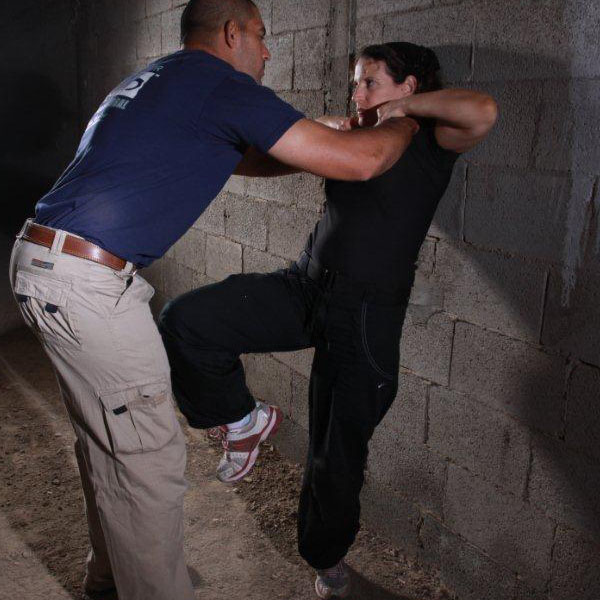
While Krav Maga recognizes that self-defense is not punishment and that the ultimate goal is to go home safely, the tenets dictate that the best way to achieve that goal is to react aggressively and decisively. For women, this is even more important, since women generally have less muscle mass and are not as accustomed to the type of hard contact that comes with a violent encounter.

Without developing aggressiveness or fighting spirit, the techniques will not matter — because under duress the defender will be unable to react in a timely or effective manner.

Core Krav Maga Principle

The Most Important Characteristics of Krav Maga
01

Practical Techniques

The main emphasis is on effectiveness, simplicity, and sound, logical problem solving. This is a street-fighting system that provides realistic defenses against a variety of aggressive attacks — whether the assailant is armed or unarmed, and whether the attack is directed at you or a third party. The system is well integrated, which means techniques and principles are applicable across multiple situations. Students learn select principles dealing with reaction time, defense, and counterattacks that apply to many different attacks.
02

Don’t Get Hurt

While this may seem obvious, the intent is far-reaching. Great lengths should be taken to avoid conflict if at all possible. An improved understanding of the dynamics of violence and violent people heightens awareness and avoidance. This heightened awareness may be even more important for women, since avoiding a violent encounter is the best way to ensure success. However, if avoidance is not possible, the defender must be aggressive in order to eliminate the threat as quickly as possible — diminishing the chances for injury.
03

Efficient Training Period

Students attain a high level of proficiency in a relatively short period of instruction. Krav Maga training has been further refined to meet the needs of citizens and law-enforcement personnel tasked with other priorities and responsibilities in daily life. ETKM’s training methodology is specifically designed to build capability using uniquely minimal training time. The system allows students to achieve life-saving skills in a relatively short period.
04

Training from Positions of Disadvantage

Life makes even the most vigilant person prone to distraction — mental lapses, complacency, or apathy. Krav Maga training takes this into consideration and forces students to train from a poor state of readiness. Training is typically conducted from a neutral position, forcing the student to perform techniques without regard to proper footwork, hand positioning, balance, or weight distribution. For training to be the most effective for reality, the techniques must not rely on being prepared.
05

Retention of Training

The system is based on common principles and natural, instinctive reactions to danger. This means techniques can be retained with minimal review and practice. What you learn stays with you because it’s built on how your body already wants to respond.
06

Performing Under Stress

Unique training methods replicate the realities of a life-threatening encounter. Training is designed to improve emotional and physical response to danger — developing the ability to recognize danger at its earliest stages, go from no state of readiness to action without hesitation, develop a fighting mindset, engage and overcome an adversary, and escalate and de-escalate using appropriate levels of force.
07

Address Immediate Dangers First

Without addressing the true problem, no technique can be successful. The most imminent danger must be taken care of first, and in the most efficient fashion. This approach not only serves to address the immediate danger, but — if done effectively — subsequent dangers as well.
08

Use What Your Body Does Naturally

Other systems may teach techniques deemed “better” under given circumstances, but most work against the body’s natural reactions and require extensive training time. They’re less likely to work under the stress of a violent encounter and often require the defender to be as strong as the attacker. Krav Maga techniques are gross motor by design — big movements driven by the whole body instead of fine motor skills, which fail under stress. This increases the likelihood of performing successfully during a real encounter and lessens the training time needed to be effective.
09

Hit Back Early and Often

A strong counterattack is vital to any realistic defense. An aggressive counter disrupts the ongoing attack, forces the attacker to react to the defender, and shifts the dynamic from victim to victor. Most criminals are looking for an easy target, not someone who fights back fiercely. An immediate counterattack surprises the attacker, creating openings for further counters and escape. Defensive actions alone do not win an altercation. You must be trained and psychologically prepared to inflict damage.
10

Attack Vulnerable Targets

Krav Maga emphasizes attacking vulnerable areas — eyes, jaw, throat, liver, kidneys, groin, fingers, knees, shins, and insteps. Strikes to these areas allow defenders to do maximum damage with minimal effort and strength. This is what makes the system effective regardless of the size difference between attacker and defender.
11

Use the Environment to Your Advantage

It’s important to evaluate every environment to determine common objects to use offensively or defensively, routes of escape, and other actions to ensure your survival. If defending in a heavily furnished room, upper body strikes may be preferred over kicks. Krav Maga training emphasizes using common objects found on the scene — blunt objects for striking, chairs as shields — to increase the chances of surviving an attack. Since fights are rarely fair, using objects from the environment gives the defender the opportunity to end the encounter more quickly.
12

Quitting Isn’t an Option

Proper training goes to great lengths, through specially designed drills, to develop a fighting spirit in each practitioner. In times of danger, the attacker controls most variables — at least initially. The fighting spirit developed through training may be the one factor under the defender’s control. It must be nurtured and cultivated. Krav Maga drills physically and emotionally empower students. The systematic process of training under varied stressors strengthens the skill set needed to perform under actual duress. The willingness to do whatever it takes to survive is the essence of the system.
13

Get Away

A “win” is not recognized by a hand being raised or a belt being worn. The goal is to go home safely — period. Training stresses that it’s critically important to defend aggressively to eliminate the threat, but simultaneously important to avoid remaining in harm’s way longer than necessary. As time passes, variables increase: introduction of weapons, additional attackers, fatigue, injury. The defender should leave the scene as soon as safely possible.

← Back to Krav Maga Info

See It for Yourself

Reading about the system is a start. Experiencing it on the mat is where everything clicks. Your first step is a free trial lesson.

Schedule Your Free Trial Lesson