ToolDevelopment
Your entire body is comprised of useful tools. Hands, elbows, knees, feet, head — and a dozen more you haven’t thought of yet. Develop your natural weapons to make them more effective.
When developing an unarmed combatives arsenal, it’s important to understand that your entire body is comprised of useful tools. Training with no limitations — reality-based personal protection — should encompass all of the tools available to you.
Not every strike is a debilitating knockout blow. Your lead hand or lead leg is often not as powerful as a rear hand or leg strike, but it is less telegraphic and can be used to set up finishing strikes. Understanding the role of each tool — setup, damage, distance control, distraction — is what separates effective training from just hitting things.
Fists
Closed-fist punches are functional and have their purpose. Straight punches, hooks, uppercuts, and hammer fists. Keep in mind proper tool-to-target matching: fists work best on soft tissue targets to reduce risk of hand injury.
Open Hands
Greater versatility than a closed fist. Palm strikes, knife-edge strikes, finger jabs to the eyes, grabs (hair, ear, groin), throat tears, fish hooks, and pinches to cause involuntary flinching. One hand, many applications.
Elbows
Dense, hard, devastating at close range. Horizontal elbows to the jaw, vertical elbows to the chin, rear elbows in tight quarters. One of the most powerful short-range tools in the system.
Knees
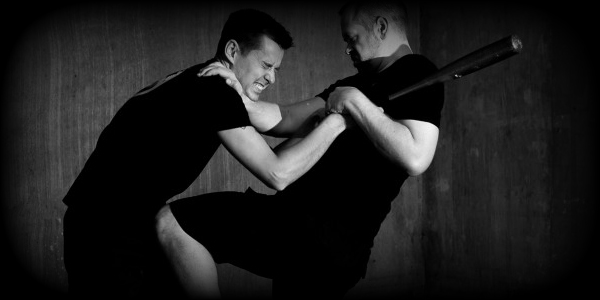
Maximum power at clinch range. Targeted at the groin, thighs, midsection, and head when controlling an opponent’s posture. Often the strongest weapon available when distance collapses.
Feet & Legs
Front kicks for distance, round kicks for damage, stomping kicks on the ground. Legs also serve defensively — “vining” an attacker’s leg during a bearhug prevents being lifted or carried.
Head
Headbutts — forward, side, rear, upward. Effective in extreme close quarters when hands are trapped or controlled. The forehead is one of the hardest surfaces on the body.
Shoulders
Defensively to protect your chin. For grinding during tactical ground fighting. To create space during self-defense applications like a choke from behind. Overlooked — but always available.
Teeth & Mouth
In extreme close quarters, biting can create space or cause an involuntary reflexive response due to the psychological effect of a person’s natural aversion to it. Last-resort tool — highly effective.
Tactile Sensitivity
Using your body’s sensitivity to feel an attacker’s movements or weight shifts without looking directly at them. Critical within grappling range or during a clinch — your body reads the fight before your eyes can.
Your reactions during a stressful encounter will be dictated by the environment in which you train. Learning to use your entire body against an attacker is another advantage of training in an eclectic fighting system like Krav Maga.
Soft Tissue vs. Hard Tissue
Match the tool to the target. Hands contain some of the smallest bones in the body — use open-hand strikes or palm heels against hard surfaces like the skull. Save the fist for soft tissue targets like the body.
Setup vs. Finish
Not every strike is a finisher. Lead-hand strikes and lead-leg kicks are faster and less telegraphic — use them to set up the rear-hand or rear-leg power shots that end the encounter.
Involuntary Responses
Biting, pinching, spitting, and eye pokes cause reflexive flinching — creating openings for follow-up strikes or space to escape. The psychological effect is as valuable as the physical one.
Feel the Fight
Tactile sensitivity lets you read weight shifts, direction changes, and grip adjustments through contact alone. In a clinch or on the ground, your body can process the fight faster than your eyes.