What Real Self-Defense with a Firearm Looks Like
What does self-defense with a firearm actually look like? Not Hollywood shootouts and tactical reloads. An in-depth analysis of 482 real-world defensive firearm incidents gives us a much clearer picture. All of these cases involved private citizens, not law enforcement officers, using firearms to defend themselves or others from criminal threats.
Here’s what the data tells us.
Where Do Defensive Gun Uses Happen?
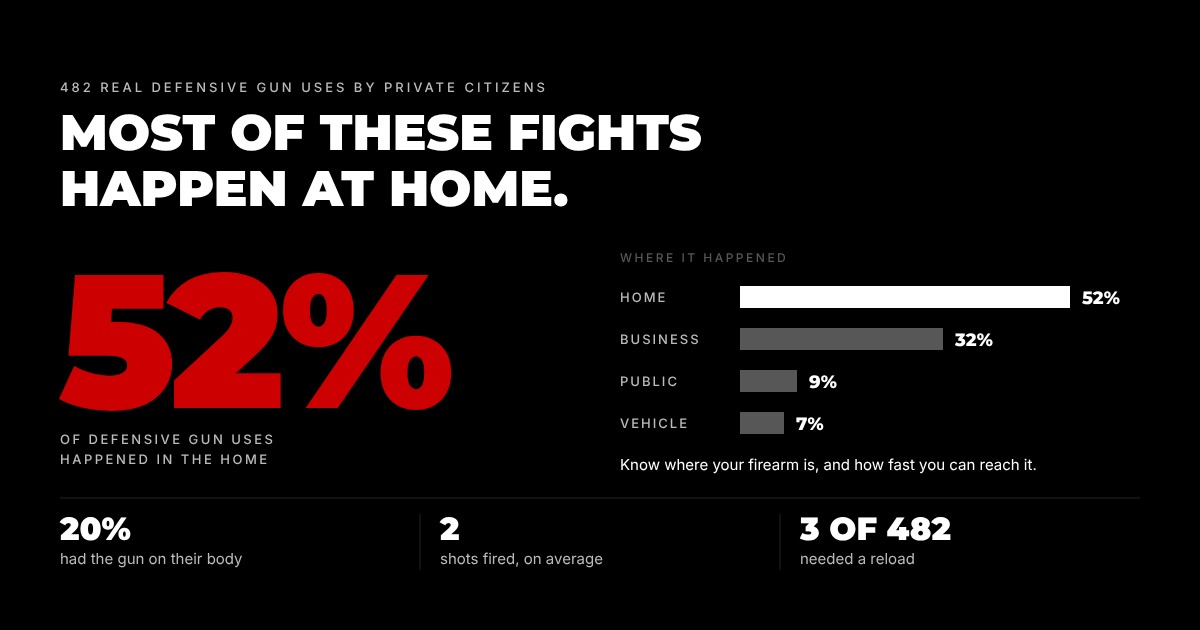
The majority of self-defense shootings happen in places we’d least expect danger, or where we feel safest:
- In the home: 52%
- At a business: 32%
- In public places (e.g., streets, parks): 9%
- In or around vehicles: 7%
- What were the attackers doing?
The most common initial crimes that triggered these incidents were:
- Armed robbery: 32%
- Home invasion: 30%
- Burglary: 18%
The takeaway? Most self-defense scenarios begin with a criminal who initiates violence, not a citizen looking for a fight.
How Many Shots Are Typically Fired?
Shots were fired in 72% of the defensive incidents.
The average and median number of shots fired: 2.
In cases where more than two shots were fired, defenders generally kept shooting until their firearm was empty. That’s a likely stress response in high-adrenaline situations.
This data suggests that in most real-life cases, firefights are short, and accurate shot placement matters more than high capacity.
What Kind of Firearms Were Used?
Handguns are the most common firearm in defensive use:
- Handguns: 78%
- Long guns (e.g., shotguns, rifles): 13%
- Unreported firearm type: 9%
Handgun caliber breakdown:
- .35 caliber family (.38, .357, 9mm): 61%
- .380 and below (so-called “mouse guns”): 23%
- .40 caliber and above: 15%
Most .38 caliber revolvers were reported to be 5-shot models, reinforcing the idea that simple, easy-to-use handguns are preferred for home and personal defense.
How Close Are Most Self-Defense Shootings?
The range was short, but generally not contact distance.
Defenders usually made the decision to shoot just before the criminal closed to arm’s reach.
Many defenders communicated or gave commands before firing.
This reinforces a principle taught in force science research: distance is time, and time is options. Maintaining distance gives you space to think, communicate, and decide whether to shoot at all. Giving clear commands may prevent the need to fire altogether.
Where Was the Firearm Kept?
Only 20% of defenders were carrying their firearm on-body at the time of the attack.
In the remaining 80%, the firearm was stored, often in another room, and had to be retrieved during the incident. This reinforces the importance of practicing quick access to your firearm, understanding storage solutions that balance safety and accessibility, and recognizing that even with delay, defenders often had enough time to retrieve a weapon.
Reloads were rare.
Reloading occurred in only 3 out of 482 incidents. One outlier involved a person using a .32 caliber revolver to kill an escaped lion, which took 13 shots. Yes, that actually happened.
How Many Attackers Were Involved?
Multiple attackers were involved in 36% of incidents.
Despite multiple assailants, there were no confirmed cases of lookouts or getaway drivers joining the fight. Most fled the scene at the first sound of gunfire.
Notable example:
A homeowner in Rochester, NY, defended against seven intruders during a series of home invasions. Using a shotgun, he killed two and seriously wounded another when they broke through his door.
How Much Time Do You Have to React?
Contrary to what you might think, most incidents did not happen in a fraction of a second.
Instead, many criminals behaved in a “shark-like” manner, circling, posturing, and signaling their intent before attacking. This gave many defenders time to identify the threat, access a stored weapon, and respond appropriately.
This supports the importance of situational awareness and mindset training, both key principles in Krav Maga and firearms self-defense.
What Happens After the Shots Are Fired?
Once a criminal is shot, the most common reactions were immediate flight or collapse.
Even small-caliber weapons (like .22s and .380s) showed notable stopping power at close range, with a 30% one-shot-stop rate when properly aimed.
In many cases, the presence of a firearm alone caused criminals to verbalize fear and retreat without a shot being fired.
Some defenders pursued the attackers, captured them, or held them at gunpoint for law enforcement.
The Overlooked Reality: Most Gunshot Wounds Are Self-Inflicted
A sobering final point: 80% of gunshot wounds in these incidents were self-inflicted, either due to negligent handling or mishandling under stress.
This highlights a critical lesson. Safe gun-handling is more important than fast shooting or tactical reloading.
Firearms are handled far more often than they are shot. Responsible storage, safe manipulation, and training under stress scenarios are essential parts of armed self-defense.
What This Means for You
The findings in this analysis make one thing clear. Defensive firearm use is often close-range, high-stakes, and over in seconds. But with the right mindset, training, and equipment, citizens can and do successfully defend themselves and their families.
If you’re serious about self-defense, don’t just buy a gun. Learn how to think, move, and act under pressure. Train your mind and body. Understand the law. Practice safety.
Your life, and the lives of your loved ones, are worth that investment.


