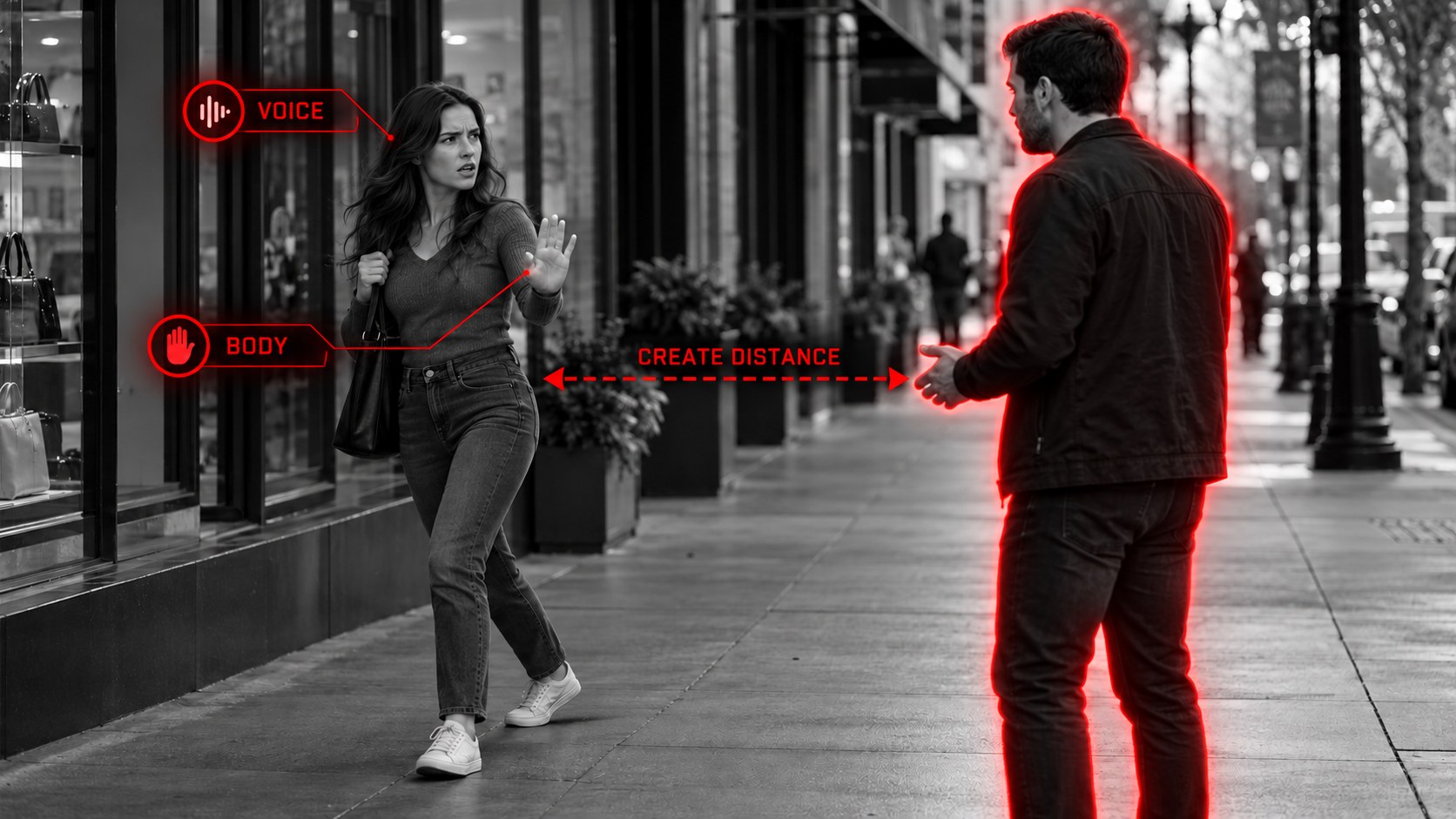
Your gut got there first. The only question is whether you let it finish the sentence.
This article closes the loop with the first one. Article 1 said the pause that gets people hurt is politeness. It gave you permission to read him correctly. This one gives you the method, so that permission turns into movement.
What the Feeling Actually Is
Something feels wrong and you cannot say why.
That is not a mood. It is your mind having already processed a hundred small things. How he moved. Where he stopped. What the question sounded like. It reached a conclusion faster than you could have reasoned your way there. The feeling arrives first because the thinking is already done.
So when your gut says something is off, it is not guessing. It is reporting.
The most expensive thing you can do with that report is explain it away so you do not seem rude or dramatic. Most people who got hurt saw it coming and talked themselves out of it.
Fear Versus Worry
There is one distinction that makes all of this usable.
True fear is rare, immediate, and specific. It shows up once, clearly, about this situation, right now. It is your mind saying this is wrong.
Worry is the opposite. It is constant, vague, and repeats itself. It is about everything and nothing. It is not protective. It is just noise, and carrying it around all day is what makes people tired and no safer.
Honor the first one. Set the second one down.
Once you can tell them apart, you stop living in a low hum of anxiety. You start living with a clear signal that only fires when it matters. That is a lighter way to walk through the world, not a heavier one.
Fact Versus Story
Your mind does not hand you raw information. It hands you a story about the information, and it builds that story fast.
He is walking toward me. That is a fact.
He is probably fine. That is a story.
He is coming for me. That is also a story.
Both stories are your mind filling a gap, and neither one is the thing you saw. The skill is small and specific. Notice the difference between what you actually saw and what you built on top of it. Then act on what you saw.
That matters in both directions. It keeps you from freezing on a stranger who was just walking to his car. It also keeps you from waving off the one who was not.
Two Signals, Move
So how do you know when the signal is real?
You do not wait for certainty. By the time you are certain, your options are gone. Instead, you count.
One signal, keep watching. He is standing a little close. Fine. Note it.
Two signals pointing the same way, change your position. He is standing a little close and he just asked if you are here alone. That is not nervousness. That is a pattern, and the answer is to move.
You will not always be right. That is the point. The moves you make at two signals are cheap. Change seats. Walk toward the counter. Pull into a different gas station. If you were wrong, nobody noticed and it cost you nothing. If you were right, you just left before it started.
Fight Back Starts Here
The freeze is real. When your mind registers a sudden threat, it can lock up while it catches up. That is wiring, not weakness.
Fight Back is the first mindset at ETKM, and most people think it means hitting. It does not. It means overriding the freeze with action. Any action. Something that breaks his control of the moment.
Stepping back is Fight Back. Saying no is Fight Back. Walking into the store is Fight Back. The hands come later, if they come at all. The habit of moving instead of standing still is the thing, and it starts the moment the signal fires, not the moment he touches you.
Your Mind Is Already Running
Something is running the whole time you are standing there, and it helps to know what it is.
You watch him. You make sense of what you are watching. You decide. You act. Then it starts over, because he changed something and now you are reading the new thing.
We call it OODA. Observe, orient, decide, act. At Level 4 you train it on purpose and learn to run it faster. The person who gets through that loop first is the one who is ahead. But you are already running it. You always were. The signal is just the first step of a loop you have been inside since you noticed him.
That is why speed matters. Every second you spend reading the story instead of the fact is a second he gets to keep.
The Line You Set in Advance
Here is the part that holds it all together.
Most of what you do in a situation runs through that loop, reading and adjusting as things change. But some things should not get reassessed in the moment. For those, you set a line ahead of time.
If this specific thing happens, I do this. Period.
Not a plan. A default. Decided at your kitchen table on a calm day, so when it fires, there is no deciding left to do. He puts himself between me and my car, I go back inside. He asks if I am alone, I am already walking. A hand goes somewhere I cannot see, I move.
The line is what keeps the loop from talking you out of it. A loop reassesses. That is its job. A default does not. That is its job.
This Week
Write one line.
Pick the place you are in most. Decide one specific thing that, if it happens there, you act on without a second thought. Write it down. Set it while you are calm, and keep it.
That is the fourth piece of your written plan. One decision that does not get reopened.
In Class
Fight Back override drills start at Level 1. Every round of pressure is a rep of feeling it and moving anyway, so the freeze window gets shorter every time.
Decision drills are where you learn to act on a read instead of waiting for proof. And OODA at Level 4 is where the loop you have always been running gets a name, a structure, and a faster clock.
A line you never trained is a sentence. Reps turn it into a response.
Next up: The Hard-Target Family. Buckling a car seat is the most distracted thirty seconds of your day. He knows that too.