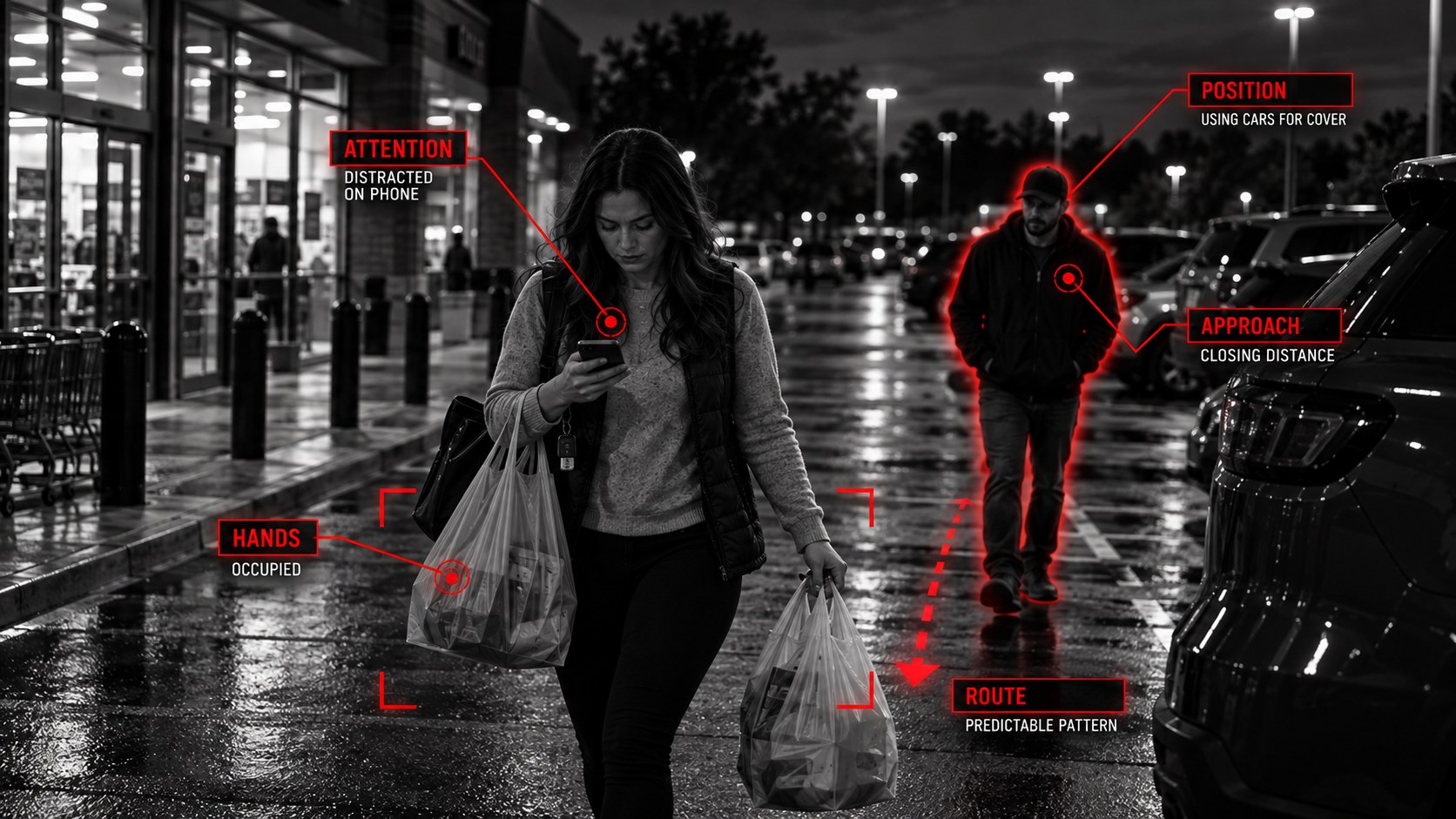
He decided before you ever saw him.
That is the part people struggle with. We like to think of violence as something that happens to us, like weather. Random. Unlucky. Nothing to do with us.
Most of it is not like that. Most of it is chosen. And the way he chooses is simpler than you think.
The Math He Ran
Every predator, whether he could put it into words or not, runs the same three-part calculation before he commits.
What can I get. What might it cost me. How hard will this person make it.
That is it. Reward, risk, difficulty.
If the reward looks good and the risk and difficulty look low, he moves. If the risk climbs or the difficulty climbs, he does something most people never expect. He walks away and finds somebody else.
That is not cowardice. It is efficiency. He is not looking for a fight. He is looking for the person who will not make it one.
Read that last line again, because it is the best news in this whole series. Two of the three numbers in his math are about you. And you can change both of them.
Chosen, Not Random
Here is why that matters so much.
If violence were random, there would be nothing to do but hope. You would be a lottery ticket.
But it is not random. It is target selection. He looks at the people available to him and he picks the one who signals the easiest time. He does not pick the person who looks like they will notice him, move, make noise, or turn the whole thing into a problem. He picks the person who looks like they will not.
That means the signals are yours. You are already sending them, right now, every time you walk to your car. The only question is what they say.
What He Reads Off You
Think about your own Tuesday.
You come out of the grocery store with a bag in each hand and your keys somewhere in your pocket. Your phone buzzes and you look down to see who it is. You walk the same route to the same spot you always park in, because you always park there. You stand at the back of the car with the hatch open and your back to the lot, loading.
Nothing about that is careless. It is just a normal person living a normal day.
To him, every piece of it is information.
Head down means you are not scanning. Hands full means you cannot react. Same spot, same time, same route means he does not have to guess where you will be. Back to the lot with the hatch open means thirty seconds where you cannot see him coming.
He is not reading your mind. He is reading your posture, your hands, your attention, and your habits. All four of those are visible from fifty feet away, and all four of those are things you control.
The Habit You Did Not Know You Had
The one most people miss is routine.
The same gas station on the way home. The same time at the gym. The same parking spot at work. The same path from the car to the front door.
Routine feels like safety because it is familiar. To someone watching, it is a schedule. You wrote it, and you handed it over without knowing you did.
That does not mean you have to live unpredictably. It means one small change a week, in one place, is worth more than you would guess.
The Fight That Never Happens
Here is where this is going.
The best outcome in self-protection is not winning. It is boring. Nothing happens. He looked at you, ran his math, got a number he did not like, and picked someone else. You never knew he was there.
That outcome is real, and it is more common than the dramatic version. It is also the one you have the most control over, because it is decided before anything starts.
We have a word for it, and the article that answers this one is about how you earn it. For now, just know that it exists. You do not have to win a fight you were never chosen for.
This Week
Walk to your car the way you always do. Do not change anything yet.
Then, when you get there, ask one question. What did I look like just now to someone who was watching?
Head up or head down. Hands full or hands free. Scanning or somewhere else. Same spot as always, or not.
Do not fix it. Just answer it honestly. That answer is your starting point, and next week we start moving it.
In Class
Situational Awareness is the first mindset you learn at ETKM, and it enters on Day 1 of Level 1.
Your coach will ask a question you already know the answer to: have you ever walked into a room and felt something was off? Everyone has. You were reading the room. You just never had a name for it, and nobody ever told you that you could get better at it on purpose.
That is what the next article is for.
Next up: How He Gets the Angle. Position, place, and the three seconds of your day you are least present for.


