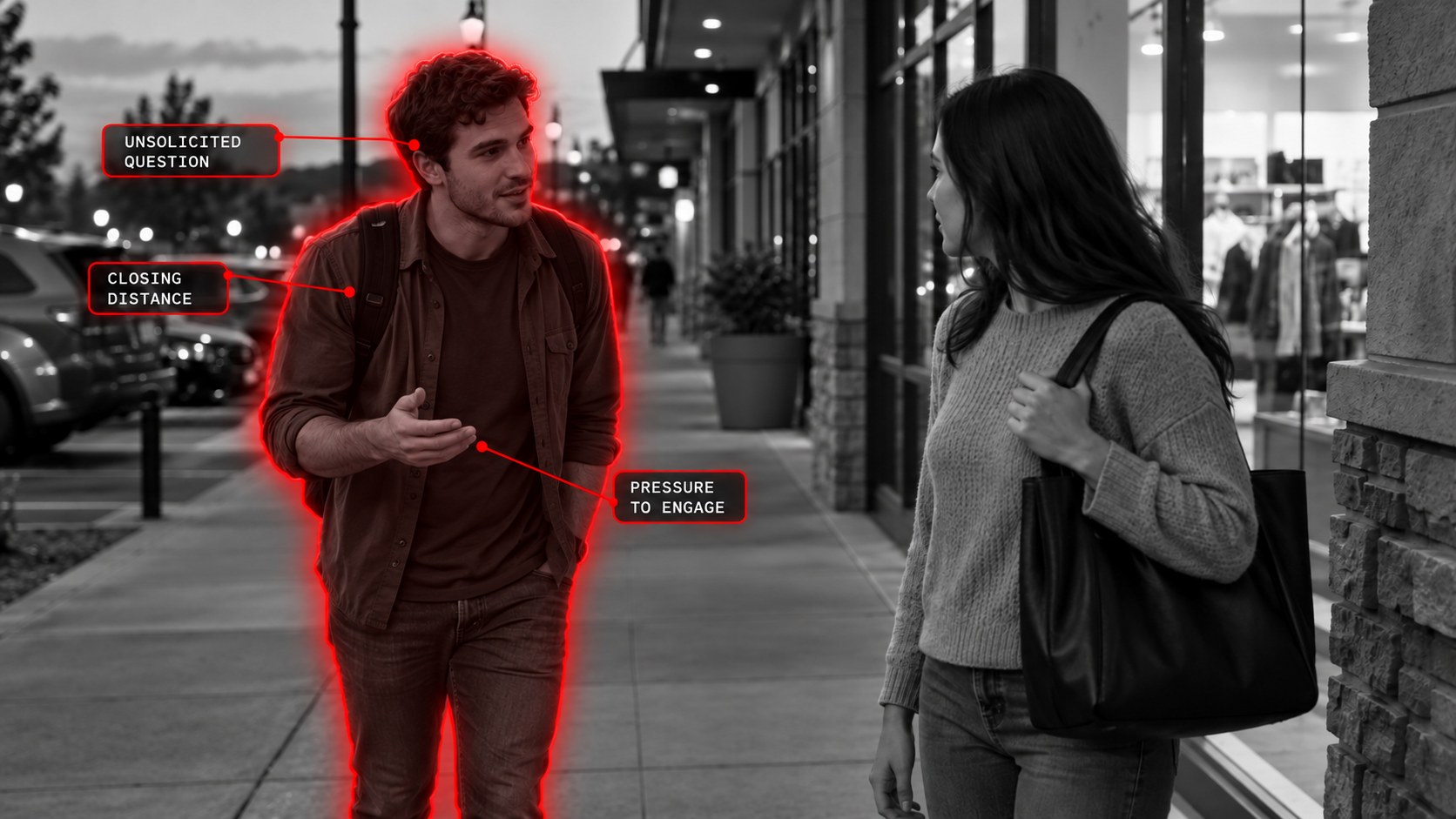
You have spent your whole life assuming the person in front of you wants what you want.
Most days you are right. The cashier wants the line to move. The guy who bumped your cart wants to get past you. The woman asking for directions wants directions.
The one day you are wrong is the day that matters. And on that day, the habit that served you every other day of your life is the thing working against you.
This series is about that day. Not to scare you. To make you precise.
The Most Dangerous Assumption You Can Make
The most dangerous thing a trained person can assume is that a violent criminal thinks the way you think.
He does not.
That is not an insult and it is not a diagnosis. It is a plain description of how he operates. You carry a set of brakes around with you everywhere you go. Guilt. Empathy. The wish to be fair. The reluctance to make a scene over nothing. Those brakes make you a good neighbor and a decent person to stand in line behind.
He has decided those brakes do not apply to him. At least not right now. At least not with you.
So every read you make of him, if you read him the way you would read a normal person, is wrong in the same direction. You give him credit he has not earned. You give him time he has not paid for. You hand him the first move because you are still deciding whether he is really doing what he is doing.
Understanding this does not make you paranoid. It makes you precise.
He Was Already Thinking Before You Saw Him
Here is the part most people never consider. He did not pick you by accident.
Before he ever spoke to you or stepped into your space, he was running a calculation. What he could get. What it might cost him. How hard you would make it. That is the whole decision, and he made it while you were thinking about what to make for dinner.
The next article is about that math and what he reads off you to do it. For now, hold onto one thing. He was thinking tactically before you knew he existed. You were not. That gap is the problem this whole series solves.
The Same Act. Two Meanings.
This is the heart of it, and it is worth reading slowly.
Every move he makes toward you looks exactly like a move a normal person makes. That is the point. It has to look normal or it would not work.
| What you see | What it means to you | What it means to him |
|---|---|---|
| He starts a conversation | Someone wants to connect | He wants information, or he wants your attention somewhere else |
| He stands close | Friendliness, or a crowded space | Position. He needs to be close to do what he came to do |
| He asks for help | Someone needs help | He is finding out whether you will stop |
| He gets louder | He is losing control of himself | He has committed, and this is how he gets what he wants |
| He backs off a little | He is being reasonable | The approach is working. You just gave him something |
| He makes eye contact | He is paying attention to you | He is measuring you |
Read the left column and you will see yourself. That is the frame you live in, and it is the right frame for almost everyone you will ever meet.
Read the right column and you will see why the same frame fails you with him. Nothing on the right is a stretch. It is simply what those acts mean to a person who is not there to connect with you.
He is not confused about what he is doing. The only person who can be confused is you, and he is counting on it.
The Pause Is Not Fear. It Is Politeness.
Here is what actually happens in the moment.
You notice something. He is closer than he needs to be. The question he asked felt a little off. He moved to a spot that puts him between you and your car. Your gut registers it before you can say why.
Then your mind does what it was raised to do. It gives you a list of reasons he is probably fine. He is probably just friendly. He probably did not notice he was standing there. You do not want to be rude. You do not want to be the person who overreacts in a parking lot.
That list takes about two seconds to read. Those two seconds are the window he was counting on.
So let’s name the pause for what it is. It is not cowardice. It is not a lack of training. It is politeness, running at the exact moment you cannot afford it, aimed at the one person who will use it against you.
Here is the reframe, and it matters more than anything else in this article.
When you see those signs, you are not misreading a normal person. You are reading him correctly.
You are allowed to act on that. You do not owe him the benefit of the doubt. You do not owe anyone an explanation for moving, leaving, or saying no. The social cost of being wrong is a moment of awkwardness you will have forgotten by Thursday. The cost of being right and doing nothing is not something you get to take back.
The Decision You Already Made
If you have been through your first class, you have heard this already. On Day 1 we ask you to make one decision before any threat ever shows up: I will fight back.
Most people hear that as a decision about being aggressive. It is not. It is a decision about who you will believe when the signs show up. The signs, or the story.
The story says he is probably fine. The signs say he is between you and your car and he just asked if you are here alone.
A person who has not decided in advance will stand there and weigh it. A person who has decided will already be moving. Same signs. Same two seconds. A completely different outcome, and the difference was settled on a calm day weeks before, not in the lot.
This article is the why behind that decision. He is not you. So the read you make of him cannot be the read you make of everyone else.
What Comes Next
He does four things, and each one has a name.
He picks. He gets the angle. He tests you. And he counts on you reading him like a normal person the whole way through.
Part One of this series walks through those four so you can see them coming. Part Two hands you what we train at ETKM to beat each one. By the end, you will have a written plan for your own life. The places you are in most. A habit for every doorway and car door. One line you say while moving. One decision you set in advance. And a plan for your family.
That is the hard target. It gets built one article at a time, starting here.
This Week
Pick one row of the table. Just one.
Then catch yourself giving the polite read once in your real day. Someone stands a little close. Someone asks for something. Notice the list of reasons your mind hands you. You do not have to do anything about it yet. Just see it happen.
That is the first rep.
In Class
Day 1, Level 1. The decision made in advance. Everything you drill after that, the stance, the strikes, the pressure rounds, only deploys if you have already decided who you will believe.
Bring the row you picked to your next class. Tell your coach which one caught you.
Next up: How He Picks. Reward, risk, difficulty, and the math he ran before he ever saw you.


