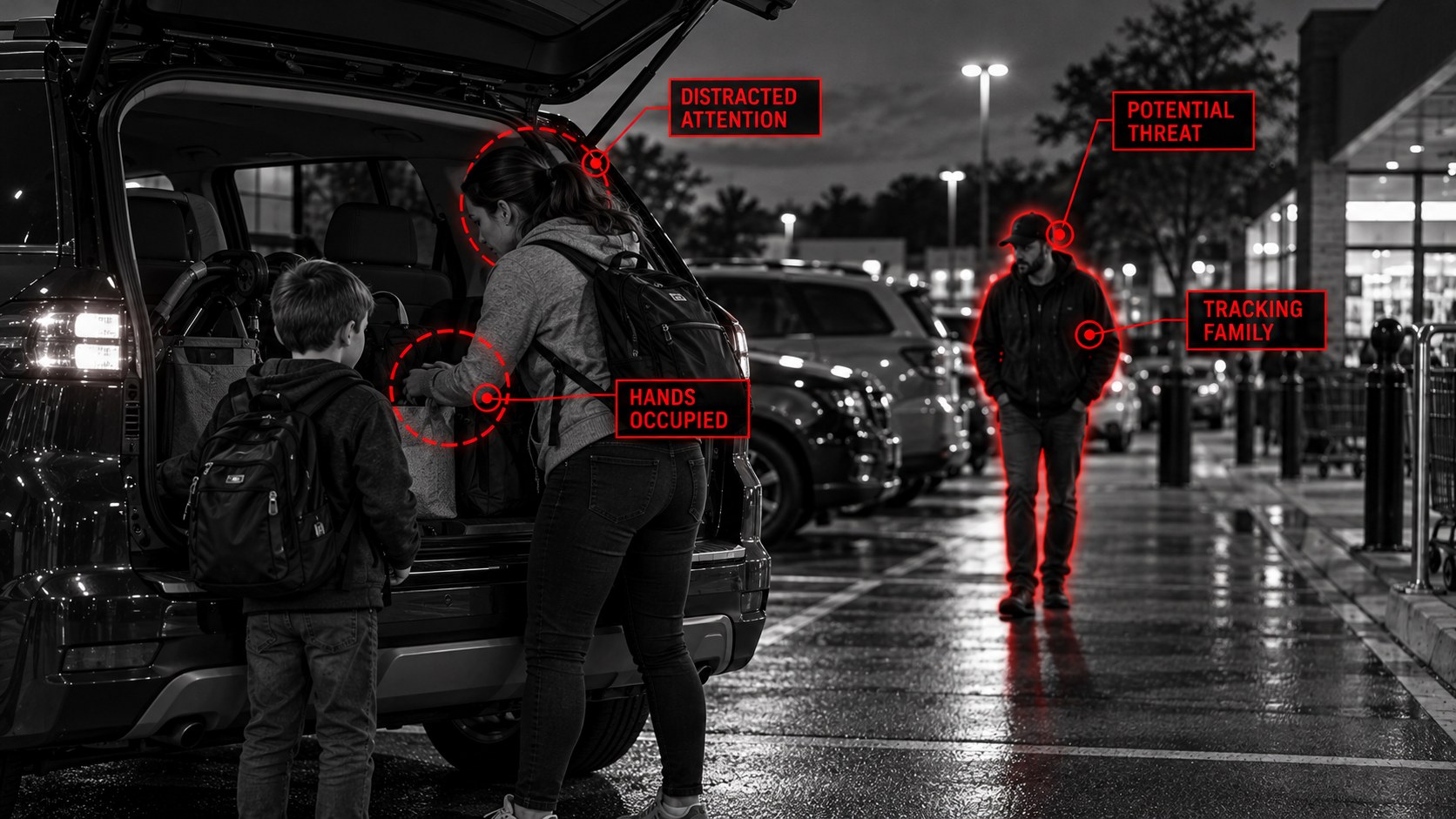
“Hey, can you help me real quick?”
Sometimes that is a question. Sometimes it is an interview.
The hard part is that both of them sound exactly the same. The words are the same. The tone is close enough. The difference is what the question is for, and the person asking is the only one who knows.
This article is about how to tell.
He Checks Before He Commits
Most people picture an attack as sudden. It usually is not.
Before he commits, he wants to know what kind of person you are. Will you stop. Will you answer. Will you let him stand a little too close. Will you go along to avoid being rude.
So he runs a test. A small one. Something that looks like nothing.
He steps into your space a little closer than a stranger should. He makes a comment that is just slightly out of line and watches what you do with it. He asks for something small, something easy to say yes to, and sees whether you say yes.
None of that is the attack. It is the test before the attack. He is checking your answer so he does not have to guess.
And here is the part that should change how you walk through the world. If you fail the test, most of the time he stops right there. Not because you scared him. Because you just raised his difficulty number, and he has other options.
The Interview
The test has a bigger brother, and it is a conversation.
Where are you headed? You here by yourself? How long are you going to be around? You work around here?
Every one of those is a question a friendly stranger might ask. Every one of them is also a question that tells him exactly what he needs to know. Whether you are alone. Where you are going. How much time he has. Whether anyone is expecting you.
You will feel it before you can explain it. The conversation feels a little off. The questions do not quite match the situation. He is a little too interested in you for someone who just walked up.
It feels off because it is not a conversation. It is reconnaissance, and you are the subject.
The Levers
He is not just asking. He is pulling on something while he asks, because a straight question is easy to say no to. So he attaches a reason you should say yes.
Urgency. This has to happen right now. There is no time to think about it.
Sympathy. I just need a little help. I am in a bad spot. Look at me.
Flattery. You seem like a good person. You look like someone who would help.
Embarrassment. Really? You are going to be like that? I just asked a question.
Authority. He has a reason you should listen to him. A uniform, a badge, a confident voice, a name he drops.
Each one of those lowers your guard a different way, and they all work because they are aimed at something good in you. You want to help. You do not want to be rude. You do not want to be the person who ignores someone in trouble.
Naming them takes their power. Once you know urgency is a lever, manufactured urgency stops feeling urgent. It starts feeling like a lever.
The Signal Inside You
There is one more thing to watch for, and it is not him. It is you.
Notice the feeling of wanting to comply.
That little pull toward saying yes. Toward stopping. Toward answering the question just to be polite and get it over with. Most of the time that pull is just you being a decent person.
But when it shows up in the middle of a conversation that already feels off, that pull is the signal. It means the lever is working. It means he found the thing in you he was looking for.
You do not have to act on the feeling. You just have to notice it, because the moment you notice it, it stops running you.
Why Answering Keeps You In It
Here is the mistake that feels like the polite thing.
He asks. You answer. He asks again. You answer again, because now you are in a conversation and walking away mid-sentence feels rude.
Every answer keeps you in the interview. Every answer gives him one more piece of information and one more second of your time. And every answer tells him you are the kind of person who stays and answers.
Engaging the interview keeps you in it. Moving, putting people around you, and not answering keeps you out.
The right answer to his question is not an answer. What that sounds like, and how to say it without being the aggressive one, is the whole next article in Part Two.
This Week
Count the strangers who open with a question.
You will get more than you expect. The cashier. The guy at the gas station. Someone in the lot. Almost every one of them is exactly what they look like.
For each one, notice two things. Did the question fit the situation? And did you feel the pull to answer? Just count. Just notice. You are learning what normal sounds like, so the off-tone one stands out when it comes.
In Class
This is why we train with a role player who talks.
Scenario-based training at ETKM is not just someone grabbing you. It is someone walking up and running the interview, with the levers, in real time. You will feel the pull to answer on the mat long before you feel it in a parking lot. That is the point. The first time you fail his test should not be the first time it counts.
Next up: Get Taken Off the List. Part Two begins. You do not have to win a fight you were never chosen for.


