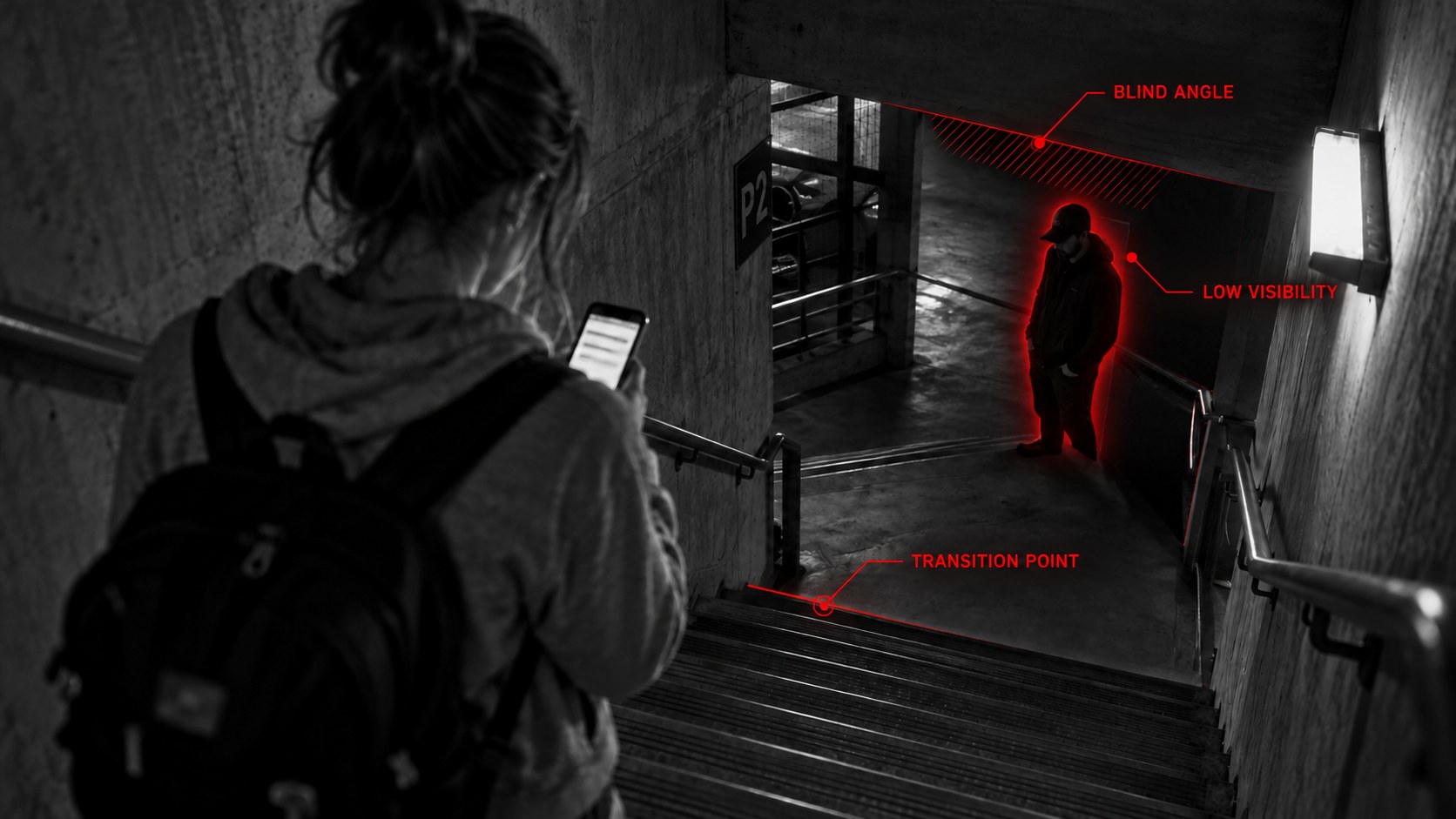
He is not trying to beat you. He is trying to have it won before it starts.
That is the difference between him and a bar fight. A bar fight is two people who both showed up angry. What he does is closer to setting a table. By the time anything happens, the chairs are already where he wants them.
This article is about where he puts the chairs.
Position
Watch where he stands.
Behind you. To your side, just outside your vision. Between you and your car. Between you and the door. Anywhere that shrinks your options and grows his.
He will not walk up and plant himself in front of you where you can see him plainly. That is the one spot that helps you. He wants an angle you have to turn to deal with, or a spot you have to get past to leave.
So the read is simple. Anyone who changes their angle relative to you, toward a position that cuts off your way out, is telling you something. Normal people drift. He moves with a purpose. The difference is small and it is visible once you know to look.
Ask one question of anyone standing somewhere that does not make sense. Why are they there?
Place
He also picks the ground.
Parking lots. Stairwells. The side of the building where the lights are out. The far end of the garage. Anywhere the crowd thins and the exits narrow.
He is not choosing those places because he likes them. He is choosing them because they do part of his job for him. A place with one way in and one way out means he does not have to control you. The space already does.
You cannot avoid every one of those places. You park in lots. You use stairwells. The point is not to fear them. The point is to know that when you walk into one, you just walked into the environment he would have chosen. Your attention needs to come up to match.
Transitions
Now the part that matters most.
The highest-risk moments of your day are not the long walks. They are the handoffs. Getting out of the car. Getting into it. Walking through a doorway. Stepping out of the elevator. Standing at the pump with your back to the road.
Transitions are dangerous for a reason that has nothing to do with him. They are the moments you are least present. You are mid-task. You have bags, keys, a kid, a phone. Your mind is already three steps into wherever you are going, or still back in wherever you just left.
He knows that. He has watched a thousand people get out of a thousand cars. He knows the exact three seconds when your head is down and your hands are busy, and he plans around it.
Those three seconds are where most of this succeeds, and the person doing it did not have to be good at anything. You were just somewhere else.
Distance Is Time
One more thing he understands that most people do not.
Notice him at fifty feet and you have every option in the world. Change direction. Walk back inside. Get in the car and lock it. Say something. Make a call.
Notice him at twenty feet and you still have most of them.
Notice him at three feet and you have almost none. At that range it is no longer about awareness. It is about hands.
That is why he closes distance before you see him coming. Every foot he gains quietly is a foot of your decision time gone. Distance is not just safety. It is time, and time is the thing that turns a bad situation into a boring one.
Why Watching Him Is Not Enough
Here is the mistake even alert people make.
Something feels off about one guy, so you lock onto him. Your whole attention narrows to that one person. Which means you have stopped watching the lot.
If there are two of them, the one you are watching is not the one you need to worry about. He is the distraction. The other one is already moving around you.
This is not a reason to be paranoid about every parking lot. It is a reason to understand that the read is about geometry, not just one face. Where are the exits. Where is the open space. Who is moving, and in what direction. That is the picture, and it is bigger than one person.
This Week
At your next three transitions, ask one question.
Who is between me and my way out?
Getting out of the car. Walking into the store. Coming back out. Three seconds, one question, three times. That is the whole assignment.
You will probably find the answer is nobody, every time. Good. You are not looking for a threat. You are building the habit of looking, so that on the day the answer is somebody, you already asked.
In Class
The first two tactics you learn at ETKM are about exactly this.
Get Off the X means stop being where the attack is going. Create Space means distance buys time, and time is what makes a decision possible. Both enter at Level 1, and both are built in drills before they are ever built in a parking lot.
If you have done Cover, Crash and Counter with your back against the wall, you have already felt what a bad position costs. He wants to put you there on purpose. The next article in Part Two is about never giving him the chance.
Next up: How He Tests You. The question that is not a question, and the interview you did not know you were in.


