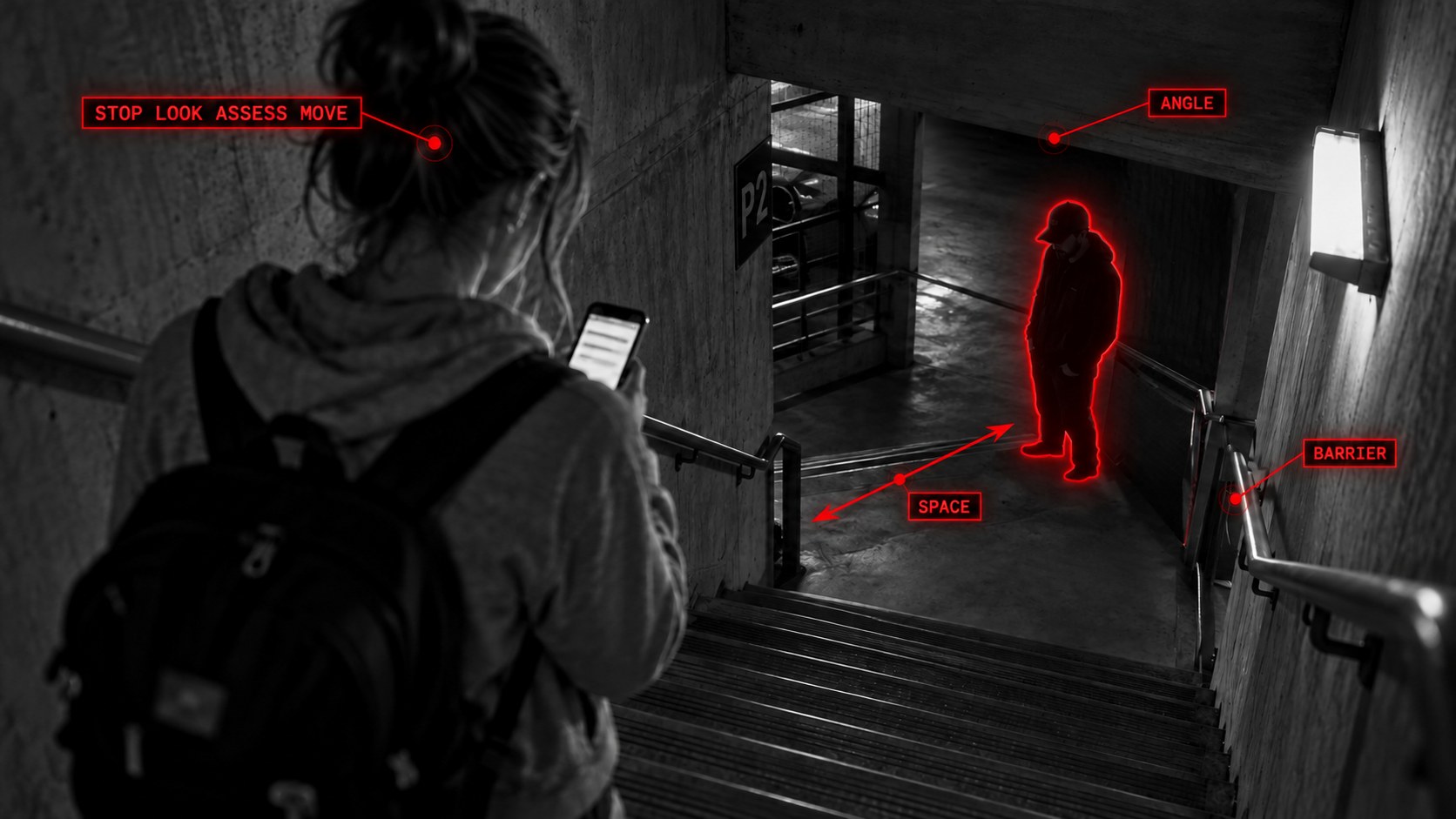
You do not have to win a fight you were never chosen for.
That sentence is the whole second half of this series. Part One showed you four things he does. He picks, he gets the angle, he tests, and he counts on you reading him wrong. Now you get the answers, one at a time.
This one answers how he picks.
Deselection
He runs his math. Reward, risk, difficulty. If the difficulty number comes back high, he moves on to someone else and you never find out he was there.
We call that deselection. It is the act of getting yourself taken off his list before anything starts. Not by being tough. By being visibly difficult to approach without being noticed.
It is the most common way a trained person stays safe, and it is the least dramatic. Nothing happens. That is the win.
Here is how you earn it.
Awareness Is Not Watching for Danger
The first mindset you learn at ETKM is Situational Awareness, and most people get it wrong before they ever walk in the door.
They think it means watching for danger. So they walk through parking lots a little tenser than they used to and call it awareness. That is not awareness. That is carrying something heavy around with nowhere to put it down.
Watching for danger collects fear. Collecting information collects things you can use. Where the exits are. How much room you have. Who is here. What normal looks like in this place right now.
That version is lighter than what you have been doing. It is also the one that works, because a person who is collecting information looks like a person who is collecting information. And that look is exactly what he is checking for.
The Color Code
We give awareness a scale so you know where you are on it.
White is unaware. Head down, phone out, earbuds in. Completely reactive.
Yellow is relaxed alert. You are present. You notice who is around you and where the exits are, and nothing about it is tense. This is where you live.
Orange is specific alert. Something has your attention. You are tracking it and getting ready.
Red is action. The threat is real and you are already moving.
Most people live in White. The goal is Yellow as your everyday baseline, not Orange. Relaxed, present, taking it in. If you are tense all day you will not last a week. Yellow costs nothing and you can hold it forever.
The Vital Few
Awareness of everything is awareness of nothing. So we narrow it.
In any place you walk into, two or three things decide how it goes. Not fifteen. Trying to watch all of it is how people end up watching none of it. We call those two or three things the vital few, and yours come out of your actual week.
Pick the five places you are in most. For most people that is the work lot, the gas station on the way home, the grocery store, the gym, and your own driveway. For each one, name the two or three things that matter.
At the gas station it might be two things. Which pump puts your car between you and the road, and whether anyone is sitting in a parked car who is not buying gas. At the grocery lot it might be where you park relative to the doors. And who is standing near the cart return with nothing to do.
Ten minutes at your kitchen table. That is the whole build.
Baseline on Arrival
One more habit, and it is the one most people skip.
When you walk into a place, take thirty seconds and notice what normal looks like. The noise level. How people are spaced. Where the staff is. The rhythm of the room.
You cannot see what does not fit until you know what fits. A person who baselined the space when they walked in is already ahead of anyone who did not. When something changes, they are the only one who notices it changed.
This is not a checklist you run with your lips moving. After a few weeks it is just what walking into a room feels like.
How You Carry Yourself
Everything above is what you see. This part is what he sees.
Head up. Deliberate pace. Brief eye contact with the people you pass. The body language of someone who notices things.
That is not a performance. It is just what awareness looks like from the outside. A person who is scanning, positioned well, and clearly present is hard to approach without being seen. He knows that. So when he sees it, he runs his math and gets a number he does not like.
Posture does one more thing. It tells you who you are. Walk with your spine straight and your head up and you will feel more switched on, because you are. Your body is not just sending him a message. It is sending you one.
It Is a Habit, Not a Personality
You do not have to become a different person to do any of this.
Awareness is trainable. It is a set of small habits that run in the background of your life. The same way you check your mirrors without thinking about it. The trained person is usually calmer than the untrained one, not more nervous, because they are not surprised by anything. They have been watching.
The first rep is the parking lot on your way home tonight.
This Week
Write down your five places.
Under each one, name the two or three things that matter. Carry that list for a week. Check it against the real place when you are standing in it. Change it when your life changes.
That list is the first piece of the written plan you are building across this series. By Article 9 you will have all of it.
In Class
Situational Awareness enters on Day 1 of Level 1, and it never leaves.
The Color Code is taught in your first class. Weekly awareness assignments keep it running between classes. Your coach will tell you to take the seat facing the door, and now you know why. You are not being paranoid. You are being hard to pick.
Next up: Own the Angle. He wants to be behind you. Where you stand decides whether he gets there.


