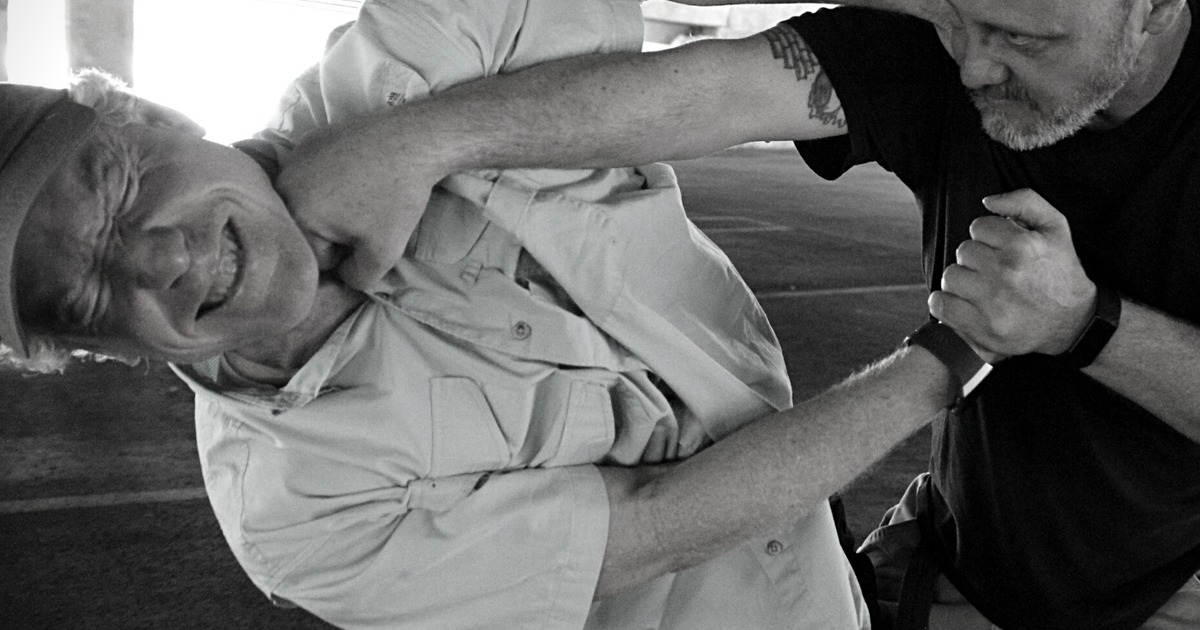
Fear Is a Signal: What Real Courage Looks Like in Self-Defense
You’ve felt it before. That jolt in your chest when someone walks too close in a parking lot. The tightness in your stomach when a conversation turns aggressive. The voice in your head that says something is wrong here.
That’s not weakness. That’s your body doing exactly what it was designed to do.
Most people spend their lives trying to get rid of fear. They think courage means not being afraid. But courage was never about the absence of fear. It’s about what you do when fear shows up.
And that changes everything about how you train.
Your Body Has a Plan. The Question Is Whether You Do.
When your brain detects a threat, real or perceived, it launches a survival program that’s been running for thousands of years. Your heart rate spikes. Your hands shake. Your vision narrows. Your hearing changes.
Research on stress physiology shows that fine motor skills start to degrade significantly as heart rate climbs. Complex motor skills and cognitive processing become unreliable at high arousal. Gross motor skills stay functional well above that threshold.
This isn’t a malfunction. Your body is running its highest-priority survival program. The problem is that this program didn’t evolve for the threats you face today. It evolved for running and hitting. Your training needs to work with the program that’s actually running, not the one you wish was.
That’s why courage isn’t about controlling fear. It’s about training your response to fear before you need it.
What Freeze Actually Looks Like
Here’s what most people don’t expect: freeze doesn’t feel like you think it will.
During a mass casualty event at a French school, students described a period of complete paralysis. They weren’t injured. The exit was accessible. They couldn’t move. The event violated their understanding of reality so completely that their nervous system defaulted to stillness.
The students who moved first had one thing in common. They had a rehearsed first move. Stand and go.
This pattern shows up everywhere. During the World Trade Center evacuation on September 11th, many occupants spent six or more minutes gathering belongings, shutting down computers, and finishing tasks before evacuating. In a building that was on fire. Research on building evacuations consistently shows that most people wait two to eight minutes after a fire alarm before beginning to move, even when they report believing the alarm is real.
The delay isn’t stupidity. It’s your brain trying to reconcile what’s happening with what it expected. Every person in every crisis moves through the same sequence: denial, deliberation, then decisive action. The people who survive compress those first two stages faster. And the only way to compress them is to train for the transition before it matters.
The First Time You Get Hit
Here’s a moment that every self-defense student remembers.
You’ve been drilling techniques for weeks. You feel good. Your form is clean. Then one day, the drill changes. Your partner doesn’t telegraph the attack. The timing is off. There’s genuine pressure.
And you freeze.
Not for long. Maybe three seconds. But three seconds is a lifetime when someone is coming at you. You didn’t forget the technique. You never trained it against surprise.
A student with years of mat time froze for three full seconds the first time genuine surprise pressure was introduced. The technique was there. The training was there. The surprise variable wasn’t.
That moment, as uncomfortable as it is, is where courage gets built. Not in the technique drill where everything goes right. In the one where your body’s alarm system fires and you have to act anyway.
Fear Is Signal, Not Weakness
This is one of the most important things you’ll learn in self-defense training: fear is signal, not weakness. No one has ever taught you how to read it.
Think of emotion as the horse and cognition as the jockey. The horse is powerful, fast-reacting, instinctive. The jockey is strategic, deliberate, slower. Under pressure, the horse takes control. You cannot remove the horse. You can train the jockey.
That’s what training does. It doesn’t make you fearless. It gives you something to do when fear arrives.
When you train under realistic conditions, your body learns what a threat feels like without the life-or-death consequence. Your stress response fires. Your heart rate spikes. Your hands shake. And then you act anyway. You throw the strike. You create distance. You scan the room.
Every time you do that, you’re reprogramming your freeze response. You’re compressing the gap between denial and decisive action. You’re building a rehearsed first move that fires automatically when your thinking brain goes offline.
Courage Is a Skill, Not a Trait
People talk about courage like it’s something you’re born with. It’s not.
Courage is a trained response. It’s the result of putting yourself in situations where fear is present and acting through it, over and over, until your body trusts the process.
That’s why a controlled training environment matters. You need a space where the stress is real enough to trigger the response but safe enough to learn from it. Where you can freeze, recover, adjust, and try again. Where the consequence of failing is a learning moment, not a life-threatening one.
That’s what we build at East Texas Krav Maga. Not people who aren’t afraid. People who know what to do when they are.
What Changes When Courage Is Trained
After a few months of stress-based training, something shifts. It’s subtle at first.
You stop avoiding eye contact in public. You walk differently. You sit closer to the door in a restaurant because you’ve already scanned the room. Not out of paranoia. Because it’s what trained people do.
You still feel fear. But the gap between feeling it and acting on it gets shorter. The freeze window compresses. The hesitation shrinks.
That’s real courage. Not the absence of fear. The ability to act through it because you’ve already practiced what comes next.
Your body already has a plan for danger. The question is whether you’ve trained a better one.
Take the First Step
You don’t need to be brave to start training. You just need to show up. Courage is what you build along the way.
Schedule your free trial lesson at East Texas Krav Maga. Come see what training looks like when it’s built for the real world, not the highlight reel.
Not ready to step on the mat yet? Download our free guide to understanding your body’s threat response and start learning what your fear is already trying to tell you.


