The Fusion of Fighting Arts: Why Krav Maga Borrows From BJJ and Wrestling
A 38-year-old father of two gets shoved backward over a curb during a road rage incident. He hits the pavement. The other man is standing over him. In that moment, every technique he has ever practiced standing up is irrelevant. What matters is what he knows about surviving on the ground.
This is why Krav Maga does not stay in its own lane.
Krav Maga is a self-defense system built for real situations. Real situations do not follow the rules of any single discipline. You get grabbed. You get tackled. You end up on the ground when you planned to stay on your feet. The system has to account for all of it, or it is incomplete.
That is where Brazilian Jiu-Jitsu and Wrestling come in. Not as separate arts bolted onto the side. As integrated tools that serve one purpose: getting you home safe.
The Escape-First Principle
Before getting into what Krav Maga borrows and why, you need to understand the principle that governs every decision.
Self-defense is an escape problem, not a fighting problem.
That single idea changes everything about how you train. You are not trying to win a fight. You are trying to create an exit window and use it. Every technique, every drill, every scenario is evaluated by one question: does this help me get out?
When Krav Maga borrows from BJJ or Wrestling, it borrows through this filter. The question is never “will this help me submit my opponent?” It is never “will this help me score a takedown?” It is always “will this help me survive and leave?”
What BJJ Brings to Self-Defense
Brazilian Jiu-Jitsu is built around controlling a fight on the ground. In competition, that means maintaining positions, advancing to dominant control, and finishing with a submission. In self-defense, the priorities shift.
Here is what matters from BJJ in a real-world context:
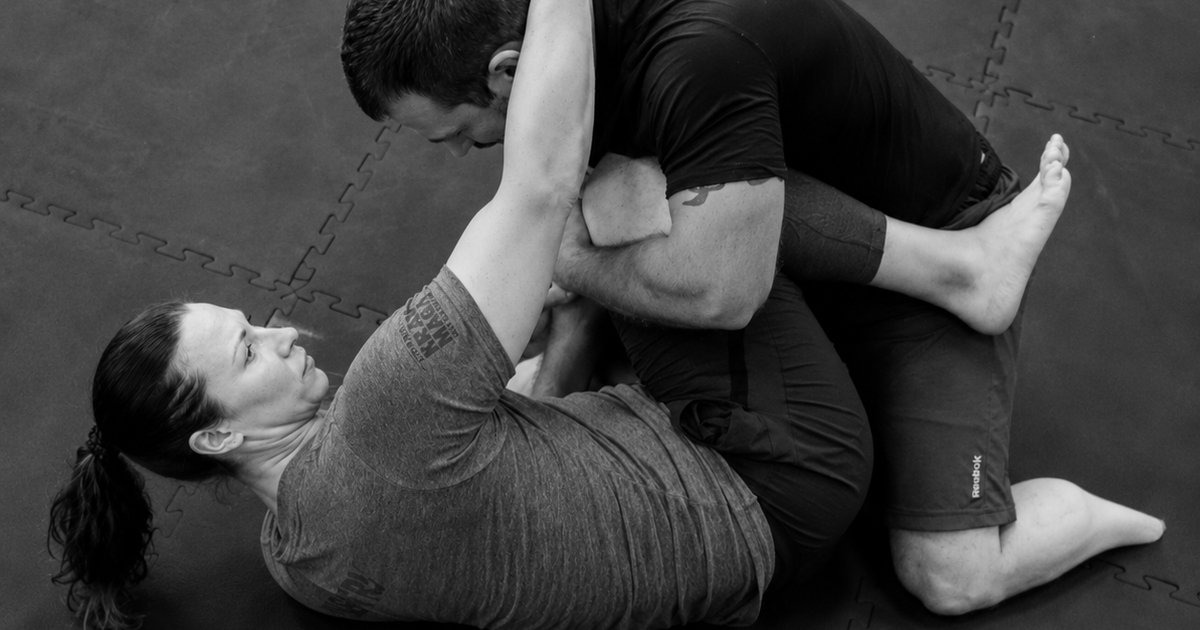
Guard recovery. You are on your back with someone on top of you. BJJ teaches you to use your legs and hips to create frames and distance. This is not about setting up a triangle choke. It is about creating enough space to get back to your feet. The guard is a survival position. It keeps weight off your chest, protects your head, and gives you leverage to move.
Sweeps for standing up. BJJ has dozens of sweeps designed to reverse positions. In self-defense, you do not need to land on top and hold the position. You need to create a moment of off-balance in your attacker that gives you a window to stand. A hip bump sweep or a simple trap-and-roll puts you on top for one second. That second is for standing up and leaving, not for staying and fighting.
Frames and distance management. BJJ teaches you how to use your forearms, knees, and elbows to create barriers between your body and your attacker’s. These frames buy you time and space. In Krav Maga training, framing is drilled as a gross-motor survival response. You do not need to remember a complex sequence. You need to create space, protect your head, and move.
The adaptation is the key. Competition BJJ rewards patience on the ground. Self-defense rewards speed getting off it. Krav Maga takes the mechanics of BJJ and compresses them into a single doctrine: protect, create space, stand, exit.
What Wrestling Brings to Self-Defense
Wrestling addresses a different part of the problem. Where BJJ focuses on what happens after you are on the ground, Wrestling focuses on what happens in the space between standing and falling.
The sprawl. Someone rushes at you and tries to tackle you. If you do not know how to sprawl, you are going down. Wrestling teaches you to drop your hips, push your weight onto the attacker’s shoulders, and keep your feet. This is one of the highest-value techniques in self-defense because it prevents the ground fight from ever starting.
Underhook control. In a close-range clinch, the person who controls the inside position controls the fight. Wrestling’s underhook is a simple, gross-motor tool that gives you leverage to turn your attacker, create angles, and move toward exits. It works in street clothes. It works when your fine motor skills are gone. It works when you are scared.
Hip movement and base. Wrestling builds an understanding of balance, weight distribution, and hip positioning that carries over to every part of self-defense. A student who has drilled wrestling hip escapes moves differently on the ground than one who has not. They are harder to pin, harder to hold, and faster to their feet.
Wrestling’s contribution to self-defense is fundamentally about staying on your feet or getting back to them quickly. That aligns directly with Krav Maga’s ground doctrine.
Principles, Not Techniques
Here is the difference between collecting techniques from other arts and integrating principles from them.
A technique is locked to the specific attack it was designed for. A principle adapts to whatever is actually happening. Techniques are like keys cut for a specific lock. Principles are like a lockpick. They work on whatever is actually in front of you.
When Krav Maga integrates BJJ and Wrestling, it is not adding a library of positions to memorize. It is adding principles. Hip movement. Frames. Base. Distance management. Underhook control. These are concepts that apply across dozens of different situations. You drill them until they are automatic, and then they show up when you need them without being called by name.
Stress removes options. The simpler the action, the more of it survives under real pressure. That is why Krav Maga does not import competition playbooks. It imports the gross-motor, high-percentage movements that hold up when your hands are shaking and your vision has narrowed.
What This Looks Like in Training
At East Texas Krav Maga, BJJ and Wrestling principles are part of the regular curriculum, not an add-on.
Ground survival drills start early. You learn to protect your head, create frames, and get back to your feet before you learn anything else on the ground. The four-step ground doctrine is simple: protect, create space, stand, exit. Every ground drill maps back to those four steps.
Standing clinch work draws heavily from Wrestling. You practice controlling inside position, defending takedown attempts with the sprawl, and using angles to disengage. These drills are run under pressure with resistance, because a skill you have never tested under stress is a skill you cannot count on.
If you have never validated it under pressure, you do not have the skill. You have a rehearsal. That is why integration drills at ETKM are not gentle walk-throughs. They are pressure-tested. You find out what works and what breaks before you need it in real life.
Why This Matters for You
You do not need a background in BJJ or Wrestling to benefit from this training. The integration is built into the curriculum. You will learn these principles the same way you learn everything else at ETKM: through repetition, progressive challenge, and realistic scenario training.
What you should know is that the self-defense system you train in does not ignore the ground. It does not pretend every fight stays standing. It prepares you for what actually happens, using the best tools available from any discipline that has proven its value under pressure.
The goal is not to become a competitive grappler. The goal is to make sure that no matter where a confrontation takes you, you have the skills to get back to your feet and go home.
Schedule your free trial lesson at East Texas Krav Maga and experience how BJJ, Wrestling, and Krav Maga come together to build real self-defense capability.
[Not ready for a class yet? Download our free guide to self-defense training and see how a principle-based system works.]


