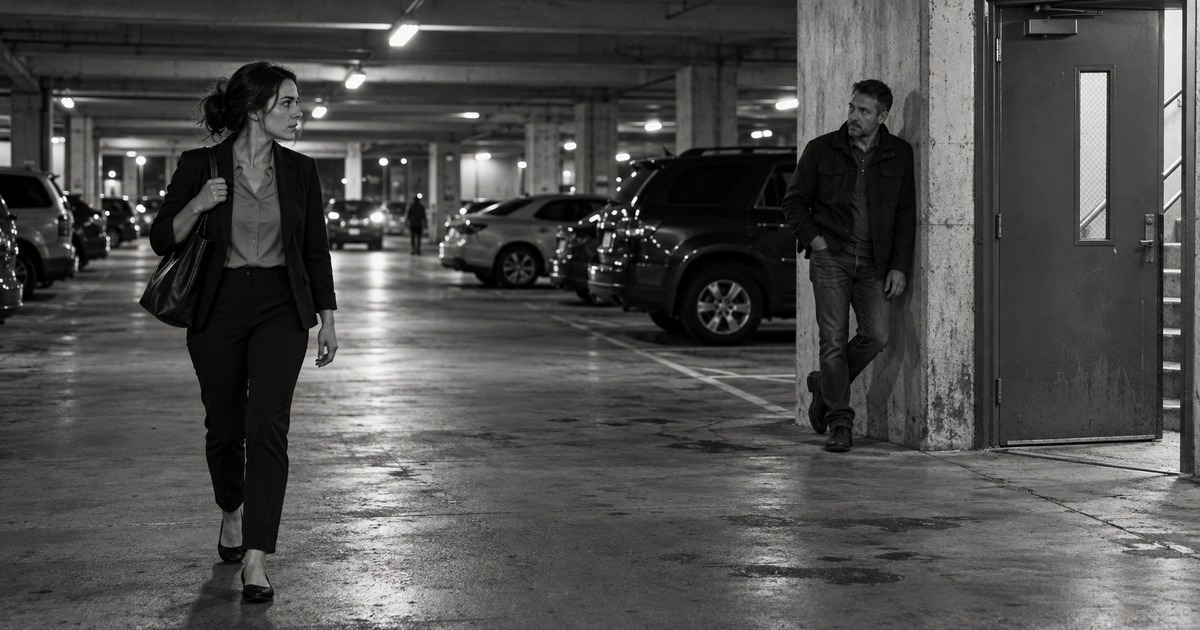
A woman is walking to her car after a late shift. She notices a man leaning against the wall near the parking garage stairwell. He is not on his phone. He is not waiting for anyone she can see. He is watching people walk past.
She does not freeze. She does not second-guess herself. She changes direction, walks toward the security desk in the lobby, and waits until other people are heading to the garage before she goes to her car.
Nothing happened. That is the point.
She read the environment (forward thinking) and executed a plan she had already built for that specific situation (backward planning). Both skills worked together in about four seconds. Neither one alone would have been enough.
Two Skills, One System
Forward thinking is the ability to read what is happening around you and anticipate what might happen next. You learned this in Part 1 of this series. It is the observation side. Baselines, cue clusters, the entry scan habit.
Backward planning is the other half. It starts with the outcome you want and works backward through every skill, decision, and habit required to reach it.
The outcome in self-defense is always the same: you go home safe. That is the end point. Backward planning asks: what has to be true for that to happen? You need the ability to read threats early. You need pre-built decisions for your highest-risk environments. You need physical skills that work under stress. You need the conditioning to sustain effort when it matters.
Start from the goal. Build the chain of skills that leads to it. Train each link in that chain until it holds under pressure. That is backward planning.
When you combine both, you get a training system that is built around real outcomes instead of technique collections.
Pre-Decision Compression
Here is where these two skills create something neither one produces alone.
We call it pre-decision compression. Deciding in advance what you will do in common scenarios compresses your response time and eliminates the most dangerous variable in any crisis. That variable is improvised judgment under adrenaline.
Your brain does not work the same way under stress. Fine motor skills degrade. Complex thinking slows. Options that seemed obvious in a calm moment become invisible when your heart rate crosses 145 beats per minute.
The decisions you have already made are the ones that survive. Pre-decision compression is the product of forward thinking (you identified the scenario) and backward planning (you built the response chain for it in advance). Together, they remove improvisation from the equation.
If you want clarity under pressure, practice clarity when pressure is low.
How This Works in Scenario Training
At East Texas Krav Maga, scenario-based drills are where forward thinking and backward planning come together.
Here is an example. You are in a simulated parking lot. Two training partners are positioned in the space. One is acting normally. One is displaying pre-attack cues: closing distance, watching you, positioning to cut off your exit.
Before any physical response, you have to read the situation. Who is the threat? Where are the exits? Are there bystanders? Is there a weapon? That is the forward thinking component.
Then you execute. You create distance. You move toward the exit. If the threat closes, you respond with the physical skills you have drilled. If it does not, you leave. That is the backward planning component: the response chain you built in training, firing in the correct sequence because you rehearsed it.
The drill is not about winning. It is about running the system. Read the environment. Execute the pre-built plan. Adapt if something changes. Get out.
Validation Under Pressure
There is a critical difference between practicing a skill and owning it. If you have never validated it under pressure, you do not have the skill. You have a rehearsal.
This is why scenario training matters more than technique repetition alone. Technique repetition builds the individual links in the chain. Scenario training tests whether the chain holds when stress, fatigue, and surprise are all present at the same time.
Forward thinking tested under pressure means reading an environment when your heart rate is elevated, when there is noise, when multiple things are happening at once. Backward planning tested under pressure means executing your pre-built response when the scenario does not go exactly the way you rehearsed it.
Both have to work under imperfect conditions. Training is where you find out whether they do.
The Pre-Mortem
One of the most practical tools for integrating forward thinking and backward planning is the pre-mortem.
Before entering any high-risk environment, spend sixty seconds imagining it goes wrong. What happened? Why? What did you miss?
Now mitigate before reality forces the correction. Adjust your route. Change your timing. Move your parking spot. Tell someone where you are going. These are not dramatic actions. They are small adjustments that cost nothing and close gaps you would not have seen otherwise.
The pre-mortem combines both skills in a single exercise. You are looking forward at what might happen (forward thinking) and building your response backward from the worst-case outcome (backward planning). Sixty seconds. No special equipment. Available to everyone.
The After-Action Review
Forward thinking and backward planning also work together after an event, not just before one.
The after-action review is a structured debrief you can run after any training session or real-world close call. Four questions: What did I observe? What mattered most? What did I actually do? What will I do differently next time?
This is how good training becomes lasting capability. Without the debrief, experience stays raw. With it, experience becomes a lesson you can build on.
This is the step that separates fast improvers from hard trainers. The difference is not effort. It is reflection.
Run an AAR after every class. Run one after every near-miss. Write it down. Two minutes. The students who do this consistently build capability at a rate that surprises everyone, including themselves.
What This Means for You
You do not need years of training to start using these skills together. Start with three things:
Pick your three highest-risk environments. The parking lot at work. The route you drive at night. The gas station you stop at on the way home. For each one, build a simple plan. What does normal look like here? What would concern you? What will you do if something breaks the pattern?
Practice reading and responding in training. If you are already training, ask your instructor about scenario drills that require you to read the environment before you respond physically. If you are not training yet, this is a good reason to start.
Debrief everything. After every training session, run the four AAR questions. After every real-world moment that made you pay attention, run them again. This is how isolated experiences become a system.
Schedule your free trial lesson at East Texas Krav Maga. Start building the skills to read threats early, plan your response, and protect the people you love.
[Not ready for a class yet? Download our free self-defense planning guide and start building your safety templates today.]


