One System, Not Six Separate Ideas
Over the last five articles, you have built something. Not a collection of tips. A system.
In Part 1, you learned why your brain locks up under threat. Adrenaline floods your system, your working memory shrinks, and your ability to think through options drops to near zero. That is not a weakness. It is physiology, and it happens to everyone.
In Part 2, you got three decision templates that cut through the freeze. Escape Route First, Loud and Clear, Self-Defense Ready. Pre-loaded responses that fire without waiting for your slow, deliberate thinking to come back online.
In Part 3, you built a mental playbook for four common scenarios. Being followed. An unexpected confrontation. A home invasion. A physical assault.
Each one with a specific, rehearsed response strategy.
In Part 4, you learned why knowing those responses is not enough. You have to condition them through repetition until the full chain fires automatically: see the cue, recognize it, fire the decision, execute the response.
In Part 5, you learned what to do when the plan breaks down. Update without defending the old call. Generate a third option. Commit to the new path.
Now it is time to connect them into one operating system that runs when you need it.
How the Pieces Fit
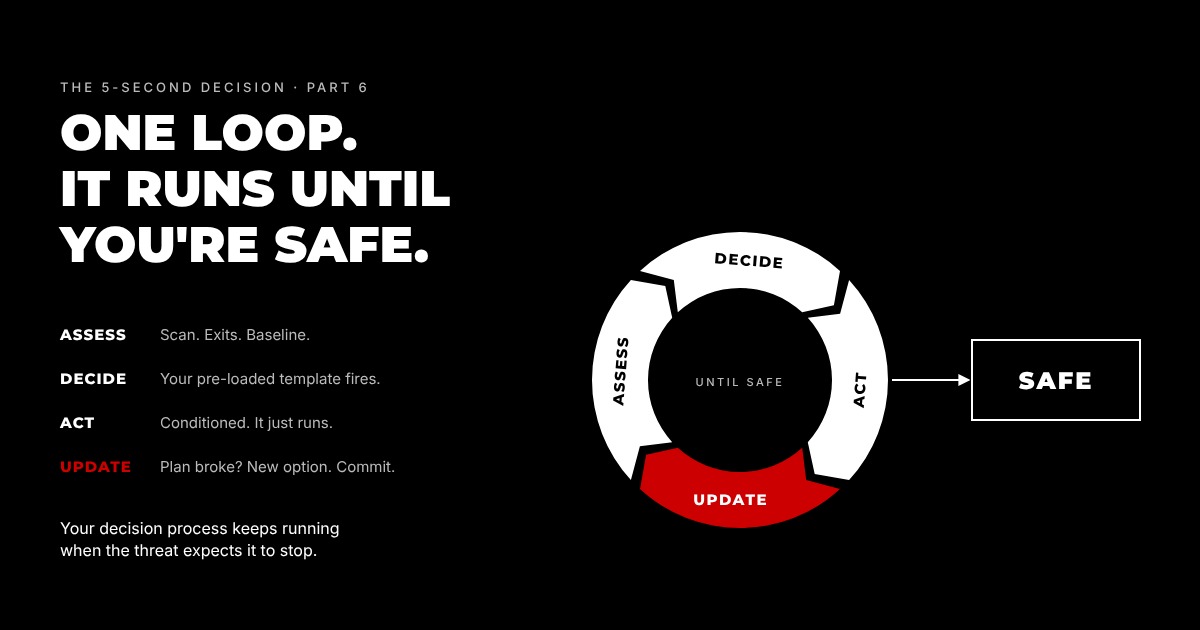
Think of your decision-making system as a loop, not a list. It is not five separate skills you use one at a time. It is one continuous process.
You enter a new environment. Your awareness skills activate. You scan, you identify exits, you read the baseline. This is what Part 1 taught you to protect: the detection phase that most people skip entirely.
Something changes. A person moves toward you. A situation shifts.
Your pre-loaded templates from Part 2 match the pattern. The decision fires.
You execute the response from your mental playbook (Part 3). The playbook tells you exactly what to do for this type of scenario.
Your conditioning from Part 4 makes that execution automatic. You do not think through the steps. They run.
Then reality throws a variable. The exit is blocked. A second person appears.
Your adaptability from Part 5 kicks in. You update, generate a new option, and commit.
The loop continues. Assess. Decide. Act. Update. Assess again.
It runs until you are safe.
Hasard Lee calls this the decision loop. In aviation, pilots train this loop until it compresses under pressure but never disappears. The same principle applies here.
You do not need to be faster than the threat. You need your decision process to keep running when your opponent expects it to stop.
The Weekly Practice Plan
A system only works if you maintain it. Here is a realistic practice plan that keeps your decision-making skills sharp between training sessions.
Daily: The Pre-Entry Protocol (30 Seconds)
Every time you transition into a new environment, practice the pre-entry habit. Before you open the car door, walk through an entrance, or exit an elevator: stop.
Scan. Identify your exits and your vital few variables. Then move.
This takes three seconds. It builds the detection phase that feeds the entire system. Most threat encounters succeed in this transition window, not because the threat was skilled, but because the target was not paying attention.
Three Times a Week: Mental Rehearsal (5 Minutes)
Pick one scenario from your playbook. Close your eyes and walk through it in real time. See the environment. See the cue.
Feel the decision fire. Watch yourself execute.
Then add a complication. Your first response does not work. Something changed.
Practice the update. Generate your third option. Commit to it.
This rehearsal keeps your templates active and your adaptability sharp without needing a training partner or a gym.
Weekly: Decision Trigger Review (5 Minutes)
Review your three personal decision triggers, the if/then rules you set in Part 2. Are they still current? Has your routine changed? Are you driving a different route to work, shopping at a different time, picking up kids from a new location?
Your decision triggers should match your actual life, not the life you had when you wrote them. Update them when your patterns change.
On the Mat: Full-Chain Training
When you train at ETKM, bring everything in this series to the mat. During scenario drills, practice the full chain: detect, decide, act. When the instructor introduces a variable, practice the update. When a drill gives you a binary choice, find the third option.
The mat is where conditioning happens. But the conditioning only transfers if you train the full decision chain, not just the physical response at the end of it.
What This System Changes in You
The five-second decision is not a trick. It is not a single technique you memorize. It is a trained process that rewires how you respond to pressure.
Before this system, a threat encounter hit your brain like a power surge. Too much input, too little processing capacity, and a freeze response that left you standing still while seconds passed.
After this system, the same threat encounter hits a brain that already has answers loaded. The detection phase is trained. The decision is pre-made. The response is conditioned.
And if the situation changes, the update protocol runs without you having to think about it.
That is not theory. That is what conditioned responses feel like from the inside. The moment arrives and your system handles it.
Not because you are braver than anyone else. Because you have rehearsed this exact moment so many times that your body stops waiting for permission.
As Bruce Siddle’s research established: you will not respond with what you understand. You will respond with what you have conditioned. Understanding gives you the blueprint. Conditioning gives you the capability.
Your Next Step
You have the system. Every piece is in place. What separates the person who read this series from the person who is actually prepared is one thing: practice.
Start with the pre-entry protocol today. Run your first mental rehearsal this week. Review your decision triggers. And when you are ready to condition these responses under real pressure with real feedback, that is what the training floor is for.
Schedule Your Free Trial Class
East Texas Krav Maga builds the decision-making system this series describes. You will not sit in a classroom. You will run scenarios, train under pressure, and build the conditioned responses that work when thinking shuts down.
Schedule Your Free Trial Class
Not ready for the mat yet? Download our free guide to building your personal safety plan and start putting these decision templates to work today.


