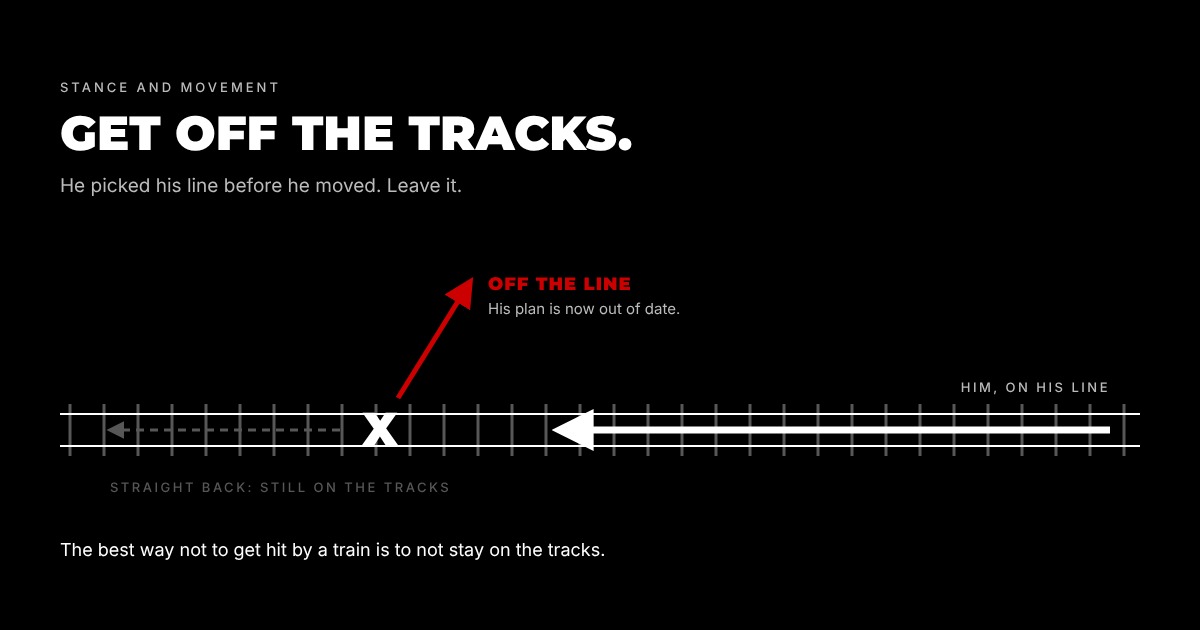
Somebody is coming at you.
Your body already has an answer. It wants to turn around and go the other way, and it wants that before you have decided anything at all.
That answer feels correct. That is the whole problem with it. It feels correct at the exact moment it costs you the most.
What is wrong with it is not a technique you are missing. It is a place you are standing.
The X Is the Spot You Are Standing On
The X is where you currently are. That is the whole definition, and it does not get more complicated than that.
Here is why that spot matters. X marks the place where his mind is focused and his targets are focused. Everything he has goes to X. Whatever he intends to do, he intends to do it there, because that is where you were when he decided.
So the instruction is short.
The X is where you currently are. You need to keep on moving.
Not moving once. Not moving when something happens. Moving is the normal state, and standing still is the thing that has to be explained.
There is one time you do not move off the X. When you have barriers or cover between you and him, you can hold. A wall does work that your feet were going to have to do. And even while you are holding, you are already picking out the next place you can get to. You are never finished moving. You are between moves.
Barriers and cover is its own article, and it runs on this same idea. That is all it gets here.
Your Body’s First Answer Is to Turn and Run
Turn around and run. That is what your body wants, and it is the oldest answer there is. Nobody taught it to you and nobody has to.
Now the correction, and the qualifier stays attached to it every time.
While he is inside your reach and coming at you, turning your back is how people get hurt from behind. You cannot see him. You cannot defend anything you cannot see. And you are moving in the same direction he was already going, which means you have not taken one inch away from him.
If that has happened to you, nothing is wrong with you. You ran the oldest program you have, and it fired before anything else got a vote.
Now read this next part carefully, because it is the part people get backward.
Running is not the problem. Running is often the goal. Getting out of there is the win, and nothing in this article says otherwise. If there is a clear lane to a door and he is not on top of you, take it. Take it without one second of hesitation and without feeling like you should have stayed and done something braver.
The mistake is narrower than that. The mistake is running blind while he is on top of you, before you have made any space or taken any angle at all. That is one specific error at one specific moment. It is not a rule against leaving.
Trains Do Not Leave the Tracks, and Neither Does He
Picture the two of you on a set of train tracks.
You are moving straight backward. He is moving straight forward. You are both on the same line, and here is the part nobody wants to hear. He covers ground going forward faster than you cover it going backward. Every person does. You can prove it in a hallway in about four seconds.
So it is only a matter of time before he reaches you. Backing up does not solve anything. It just spends the time you had.
What trains do not do is make quick decisions and move off those tracks. Neither do attackers. He picked his line before he started moving, and he is on it.
So you leave the tracks. A sharp movement to the side, or forward at an angle. Not a drift. Not a lean away from him. You get off the line he is running on.
Getting off the train tracks. That is the whole idea and it is worth calling it what it is.
This is not theory and it is not new. It happens every day and a lot of it is on video. Body cam footage is full of the same two outcomes.
A man being closed on who steps off the line stays on his feet and stays in the fight. A man who stays on the line gets run over. Same threat, same closing speed, and the only difference between them is whether one of them left the tracks.
Notice what staying on the line actually costs, because it is worse than taking a hit. You do not just absorb the impact and carry on. You end up underneath somebody, on the ground, in the worst position available to you, and every option you had one second earlier is gone. That is what the tracks buy you.
The whole variable is the step. Not size. Not speed. Not nerve.
Which brings up the question you have been holding since the first line of this article, and most people never say it out loud.
What if he is bigger and faster than me.
You are not going to outrun him, and you do not have to. Speed is not the contest.
He is running a plan built on where you were standing. The second you leave that spot, his plan is out of date. He has to see that it changed, work out what it means, and pick a new one. All of that takes time, and you are the one who just handed him that bill.
There is a name for what he is doing, and you are doing it too. Observe, orient, decide, act, over and over, the whole time. We call it OODA. Getting off the X does not make you faster inside that loop. It makes his answer wrong. He is still solving the problem you already left.
A slower person who breaks the line beats a faster person solving a problem that stopped existing two seconds ago.
You Earn the Door by Breaking the Line
Escape is still the win. Nothing here argues with that. This is an argument about order, not about goals.
The door does not exist while you are standing on the X with him closing. There is no lane, because he is filling the only one you had.
Getting off the X is what creates the door. You break his line, his plan goes stale, and in the space that opens up there is now a way out that was not available to you a second earlier. Same room. Different position.
You earn the door by breaking the line first.
Here is the whole article in one sentence, and it is the one to keep.
The best way not to get hit by a train is to not stay on the tracks.
Now the honest part. You know you should move at an angle, and you have no idea which angle or which foot goes first. That is a real gap and it is the next article, not something this one was hiding from you.
Training Saves Lives
Something changed while you were reading, and it was a belief, not a skill.
You now know why backing straight up fails. You cannot yet do anything else about it, because nothing above told you which direction to go or which foot moves first. That is not a shortcoming on your part. That is the difference between understanding a thing and owning it.
And the next article will not close that gap either, because reading cannot.
Under real pressure you do not do what you decided. You do what you rehearsed. A direction you have never actually stepped is a sentence on a page, and a sentence does not fire when somebody is closing the distance on you. Your feet have to have been there before.
If you have never heard of us, we are a self-protection school in Tyler, and this is the kind of thing a first class works on.
Attend a free trial class in Tyler. Stand on the X, have somebody walk at you, and find out how small the movement actually is.
Not ready to walk in yet? Download the free Self-Defense Starter Guide and start at the quiet end of it, long before anybody is coming at you.


