If you’ve trained at East Texas Krav Maga for any length of time, you’ve felt Lee Morrison’s influence. You may not know his name. You may never have read any of his books. But the way we train mindset, the way we structure our response to a threat, the way we think about awareness before we think about striking, all of that carries Morrison’s fingerprints.
Morrison is the founder of Urban Combatives, a system built from decades of real-world experience in close-quarter violence. He’s not a Krav Maga instructor. But his thinking aligns so closely with what makes Krav Maga effective that his ideas have become part of how we teach.
Here’s why his philosophy matters to your training.
Mindset Is the Foundation. Everything Else Sits on Top of It.
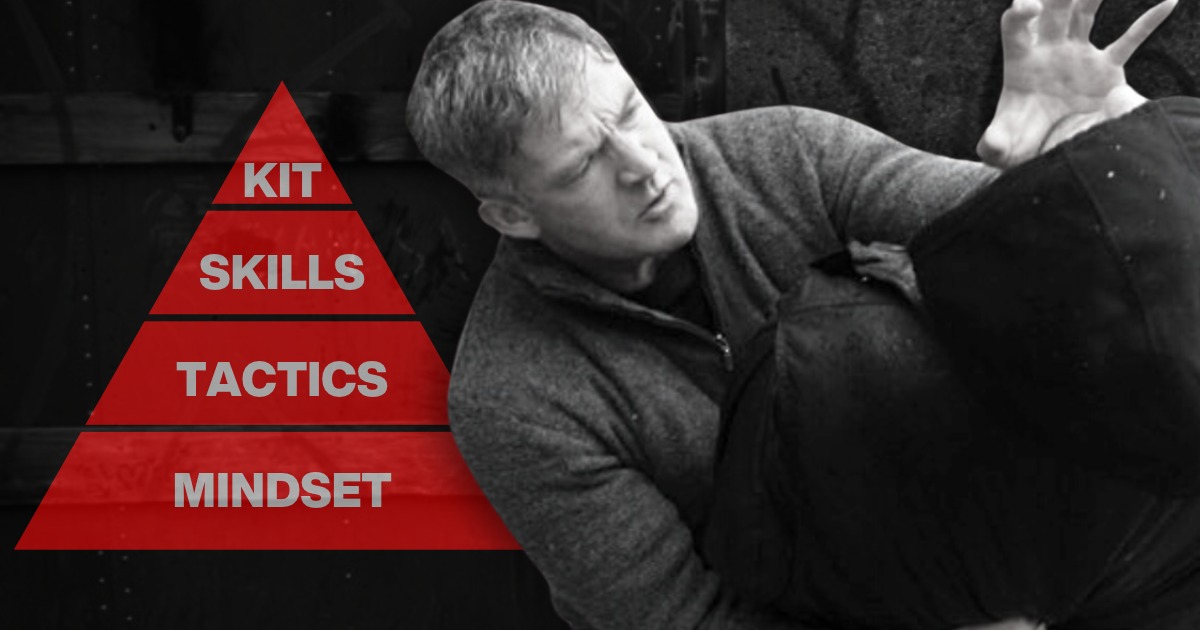
Morrison teaches a concept called the Vital Pyramid. It comes from John “Lofty” Wiseman of the British SAS, and Morrison adapted it for civilian self-protection. The pyramid has four layers. At the top sits kit, your tools and gear. Below that, skills. Below that, tactics. And at the base, holding everything up: mindset.
The point is simple and easy to miss. No amount of gear compensates for a lack of willingness to act. No technique works if the person throwing it has already decided they’re going to lose. Mindset is the layer that makes everything above it functional.
Morrison puts a number on it: “The conflict part, if unavoidable, is made up of 90 percent attitude and 10 percent skill.”
That doesn’t mean skill is unimportant. It means skill without the right mental foundation won’t perform under pressure. This is why we don’t start class by teaching a new technique. We start by putting students into a mental state where learning can take root. The physical comes after the mental is set.
This is also why we spend time in class talking about what a real threat looks like before we drill the physical response to it. If a student has never considered what they’d do if someone followed them to their car, the first time they face that scenario in training, their brain locks up. But if they’ve already thought it through, even briefly, the physical tools have somewhere to land.
See It Before It Happens
Morrison’s second core principle is one we return to constantly: awareness comes before everything.
He says it plainly: “It really doesn’t matter what your skill level is, nor the weapon you carry. If you don’t see it coming, you can’t deal with it.”
This challenges a common assumption in martial arts training. Many systems spend most of their time on physical technique and almost no time on the skill of seeing trouble before it arrives. Morrison flips that priority. Awareness is the most important capability you can build. Physical skills exist for when awareness has done its job and you’ve determined there’s no other way out.
In our classes, this shows up in how we teach students to read an environment. Where are the exits? What does normal behavior look like in this setting? When someone approaches you, what are you looking for in their body language, their hands, their eyes?
Morrison uses a framework from the military: the OODA Loop. Observe, Orient, Decide, Act. You’re constantly observing your environment. When something catches your attention, you orient on it and determine whether it’s a threat. Then you decide what to do. Then you act. And then you cycle back to observing again, because the situation has changed.
The person who cycles through this loop fastest controls the encounter. Training this isn’t about becoming paranoid. It’s about becoming present.
Avoid When You Can. Act When You Must.
This is where Morrison’s philosophy surprises people who expect combatives training to be all about fighting.
Morrison is direct about it: “If you can avoid, escape or de-escalate any situation then you should. Ego and retribution have no place in self-protection.”
His complete response framework, what he calls the Game Plan, is a spectrum. It starts with awareness. Then moves to avoidance and escape. Then situational control. Then de-escalation. Only after all of those options have failed does it move to physical action. And after the physical, the immediate priority is escape again.
The physical portion is not the goal. It’s the contingency. Morrison is clear that the best self-protection option is simply: “Don’t be there.”
This is one of the most important lessons in our training. You build aggressive physical capability so you have it when nothing else works. But you also build the judgment to recognize when you don’t need it. The strongest response you can give to most dangerous situations is to leave before they become dangerous.
The Emotional Engine
Morrison’s work goes deeper than most self-defense training into the role of emotional state in a confrontation. He maps a direct chain: how you think affects how you feel. How you feel affects what you do. What you do affects the outcome.
This isn’t motivational speaking. It’s operational.
If you walk into a potential threat thinking “this guy is going to hurt me,” that thought produces fear. Fear produces hesitation. Hesitation produces late reactions. Late reactions produce bad outcomes.
If you walk into the same situation thinking “I see what’s happening, I know my options, and I’m ready to act on any of them,” that thought produces clarity. Clarity produces decisive movement. Decisive movement changes the outcome.
Morrison teaches that you can train this. The emotional state you bring into a confrontation is not fixed by personality. It’s a skill, developed through the same kind of repetition and conditioning that builds physical technique. His crisis rehearsal protocol takes students from relaxed visualization all the way through full-contact scenario work, progressively building the ability to access a functional emotional state under real pressure.
In our classes, this is why we don’t just teach technique in isolation. We layer in stress, noise, fatigue, surprise, and decision-making. Because a palm strike practiced in a calm room is a different skill than a palm strike thrown after you’ve been shoved, you’re breathing hard, and you have two seconds to decide what’s happening.
The Ethical Line
Morrison is one of the most aggressive voices in modern self-defense. He teaches pre-emptive striking. He talks about overwhelming force. He uses language that doesn’t soften what violence actually looks like.
But underneath that intensity sits a clear ethical framework that aligns with how we train.
Morrison puts it this way: “I will only use violence if there is absolutely no choice, because I want to live, I need my family, and they need me. I am too important to lose.”
The motivation matters. A criminal uses violence because they can. A trained protector uses it because there is no other option and the stakes are too high to lose. Morrison acknowledges that violence is ugly. It’s not cinematic. It’s not heroic. It’s a last resort that exists because sometimes the alternative is worse.
He also draws a line that matters: ego and retribution have no place in self-protection. If you’re fighting to prove a point, you’ve already made the wrong decision. The only reason to use force is because you or someone you care about has no other way out.
This is why we train capability and restraint together. You learn to hit hard because there may come a day when hitting hard is the only thing between you and serious harm. You also learn to read situations, manage distance, use your voice, and leave when leaving is possible. The goal was never to win a fight. The goal is to go home.
This distinction matters because it shapes how students carry themselves outside the gym. A person trained only in aggression looks for fights. A person trained in capability and judgment avoids them. That second person is harder to build, but far more valuable to their family and community.
What This Looks Like on the Mat
Morrison’s philosophy isn’t something we lecture about and then set aside. It’s embedded in how every class runs.
When you practice scenario drills and have to decide whether to de-escalate or act, that’s Morrison’s Game Plan in action. When we train strikes with pads at full intensity after a fatigue drill, that’s his Vital Pyramid at work: testing whether your mindset holds when your body is spent. When you work awareness exercises before you throw a single punch, that’s his principle that seeing it first matters more than what you do after.
His thinking also shows up in a framework we use constantly: if they can’t see, they can’t fight. If they can’t breathe, they can’t fight. If they can’t stand, they can’t fight. It’s a targeting principle that strips away complexity and gives you three clear priorities in a situation where clear thinking is the hardest thing to maintain.
None of this is theoretical for us. It’s Tuesday night at 6 p.m. It’s a room full of regular people, parents, nurses, accountants, college students, building skills they hope they’ll never need but refuse to be without.
Morrison didn’t build Krav Maga. But his thinking sharpened how we teach it. And if you’ve trained with us, you’ve already felt the difference.
Your first step is a free trial lesson. Come see what training looks like when mindset, awareness, and capability are built together from day one.


