Something happened to you. And your body still remembers.
Maybe you flinch when someone stands too close. Maybe your hands shake in a crowded parking lot. Maybe you lie awake rehearsing what you should have done, even though that night was years ago.
None of that is weakness. Your nervous system is doing what it was designed to do. It recorded something dangerous, and now it watches for it everywhere. The problem is not that your body reacts. The problem is that no one ever showed you what to do with that reaction.
That is where training comes in.
Your Body Kept the Record
Trauma creates a specific kind of disconnect. Your body sounds the alarm, but your mind has learned to override it, shut it down, or freeze in place. Over time, that disconnect becomes the default. You stop trusting yourself. You stop trusting the signals your body sends you.
Research backs this up. Gavin de Becker documented it in The Gift of Fear. People who experienced violence almost universally reported warning signals they chose to ignore or suppress. The body knew. The mind overrode it.
For someone who has been through abuse, that pattern runs deeper. You may have spent months or years learning to silence your own instincts because the person hurting you punished you for listening to them. The alarm still works. You just stopped trusting it.
Physical training does not erase what happened. But it does something therapy alone sometimes cannot. It reconnects you to your body as something that belongs to you. Something that can act, not just react.
What Reconnection Looks Like in Training
Self-defense training for trauma survivors is not about becoming aggressive. It is about learning that your body is capable of protecting you and that you have the right to use it.
At East Texas Krav Maga, training starts with a simple idea: you are worth defending. That is not a slogan. It is the first skill. Before any technique, before any drill, that belief has to take root. For someone who has been told, through words or actions, that they do not matter, that belief can be the hardest thing they build.
Here is what that looks like in practice.
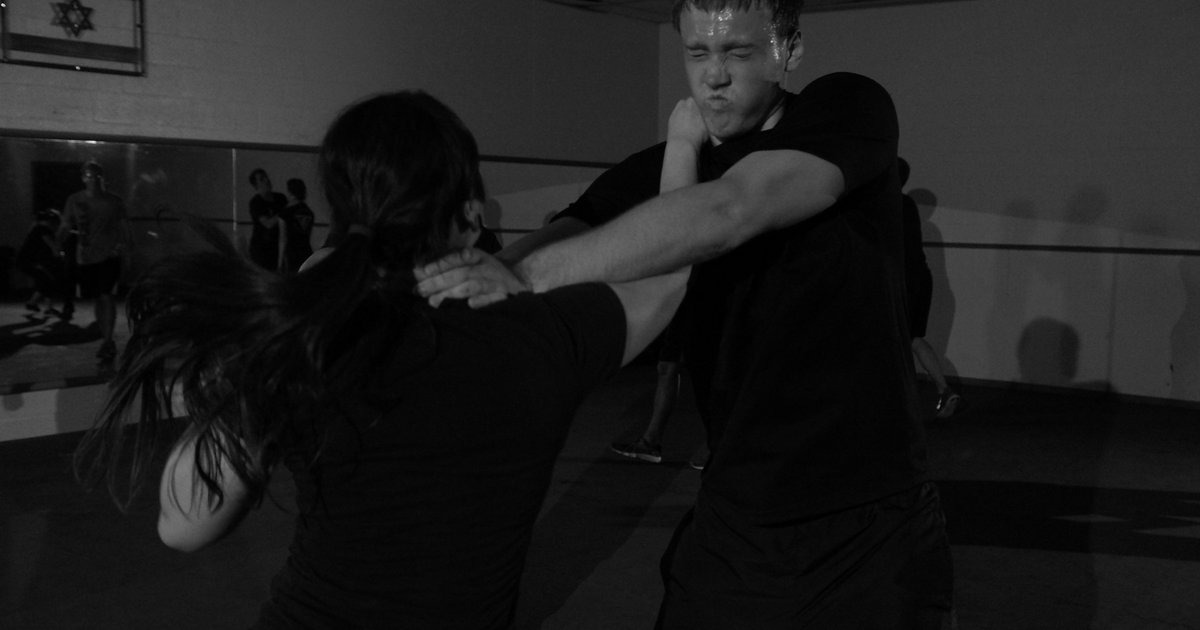
You learn to take up space. Stance work, movement drills, and striking all require you to plant your feet, use your voice, and commit to an action. For someone who has spent years making themselves small, that is not just a physical skill. It is a statement.
You learn to set boundaries with your body. Krav Maga teaches you how to create distance, control space, and stop someone from closing that distance. Gavin de Becker put it plainly: “No is a complete sentence.” Training gives your body the capability to enforce what your voice already knows.
You learn that your stress response is not broken. In Lt. Col. Dave Grossman’s research, he documented that stress reactions like tunnel vision, auditory exclusion, and the freeze response are not flaws. They are predictable human responses to threat. PTSD is not a character flaw, Grossman writes. It is an injury pattern. When you understand what your body does under stress, and you practice working through it in a controlled environment, the response stops controlling you. You start controlling it.
You learn that capability is built, not granted. Amanda Ripley found the same thing in The Unthinkable, across disaster survivors, first responders, and everyday people. Better instincts can be built. Survival is not a personality trait. It is a practiced set of decisions. You do not need to be born tough. You need to train.
Why Physical Training Matters for Trauma Recovery
Talk therapy is valuable. ETKM does not replace it and never claims to. But talk therapy operates in the thinking brain. Trauma lives in the body. And the body needs its own kind of practice to heal.
A therapist can help you name what happened. Training helps you practice what you would do if it happened again. Those are different skills. They work on different systems. Both matter.
When a survivor trains, something happens that conversation cannot replicate. Their hands learn to strike. Their legs learn to create distance. Their voice learns to project. Each repetition writes a new pattern over the old one. Not the pattern of freezing. Not the pattern of compliance. The pattern of action.
This is not metaphor. The nervous system adapts to what you practice. If you practice freezing, your body gets faster at freezing. If you practice moving, striking, and getting off the line of attack, your body gets faster at that instead.
Varg Freeborn calls emotional regulation a combat skill. He is right. And it is trainable. You do not need to wait until you feel brave to start. You start, and the capability builds the feeling.
What Survivors Actually Experience at ETKM
You will not be thrown into a room full of strangers and told to fight. That is not how this works.
Your first class starts with a conversation. The instructor wants to know what brought you in and what you need. You train at your pace. You choose your training partners. You control how much contact you are ready for.
The training environment is built around a few non-negotiables. No one grabs you without your permission. No one pushes you past the boundary you set. If you need to step out, you step out. No questions. No judgment.
Over weeks and months, something shifts. You stop apologizing for taking up space. You stop second-guessing the discomfort in your gut. You start to notice what your body is telling you before the thinking brain tries to talk you out of it.
That shift does not come from being told you are strong. It comes from proving it to yourself, one drill at a time.
The Training Environment Matters
Not every gym is safe for someone carrying trauma. The wrong environment can do more harm than good. An instructor who yells in your face during a drill is not building toughness. They are re-creating the conditions that caused the damage.
At ETKM, instructors are trained to recognize the signs of a trauma response. If you freeze during a drill, you are not pushed through it. You are given time. You are given options. You are given control. That is the point. Control is the thing that was taken. Training gives it back.
The community matters too. Training alongside other women, other parents, other people who walked in nervous and unsure creates something isolation cannot. You see someone who started where you started. You watch them grow. And then one day, someone watches you.
Isolation is one of the lasting effects of abuse. The training floor breaks that pattern. Not with forced conversation or group therapy. Just with shared effort. You hold pads for someone. They hold pads for you. You both finish the drill tired and a little more capable than you were an hour ago. That simple exchange builds trust in a way that talking about trust never can.
What the First Few Weeks Look Like
The first class is the hardest one. Not physically. Emotionally.
You might feel your heart race when someone demonstrates a grab defense. You might need to step to the side of the room for a minute. You might leave the first class and cry in your car. That is normal. That is not failure. That is your nervous system meeting something new and deciding whether it is safe.
By the second or third week, something small shifts. You throw a palm strike and your hand does not shake afterward. You practice a wrist release and realize your shoulders dropped. You make eye contact with a training partner and do not look away first.
These are not dramatic moments. Nobody claps. But they are the moments where the old pattern starts losing its grip.
By the end of the first month, most survivors report the same thing. They feel different walking to their car. Not because they learned a specific technique. Because their body remembers what it felt like to move with purpose instead of fear.
That is what earned confidence feels like. Not the kind someone gives you. The kind you built.
This Is Not About Fighting
Training is not about winning a fight. It is about knowing you could protect yourself if you had to, and living differently because of that knowledge.
Before training, the internal conversation sounds like this: “I hope nothing happens. I would not know what to do.”
After training, it shifts: “I know what I would do. And I have practiced it.”
That shift changes how you walk into a parking garage. How you respond when someone crosses a boundary. How you carry yourself at work, at the store, in your own home. Not because the world got safer. Because you got more capable.
Some survivors describe it this way: “I stopped planning escape routes and started just living.” Others say it simpler: “I feel like I belong in my own skin again.”
The goal is not to make you dangerous. The goal is to make you confident, capable, and ready. The goal is to make it home.
Your Next Step
If something in this article felt familiar, you are not alone. And you do not have to figure this out by yourself.
Schedule your free trial class at East Texas Krav Maga. Tell us what you need. We will meet you where you are.
You deserve to feel safe in your own body again. Training can help you get there.
Schedule Your Free Trial Class
Not ready to walk in yet? Download our free guide to choosing a self-defense program and take the first step on your terms.


