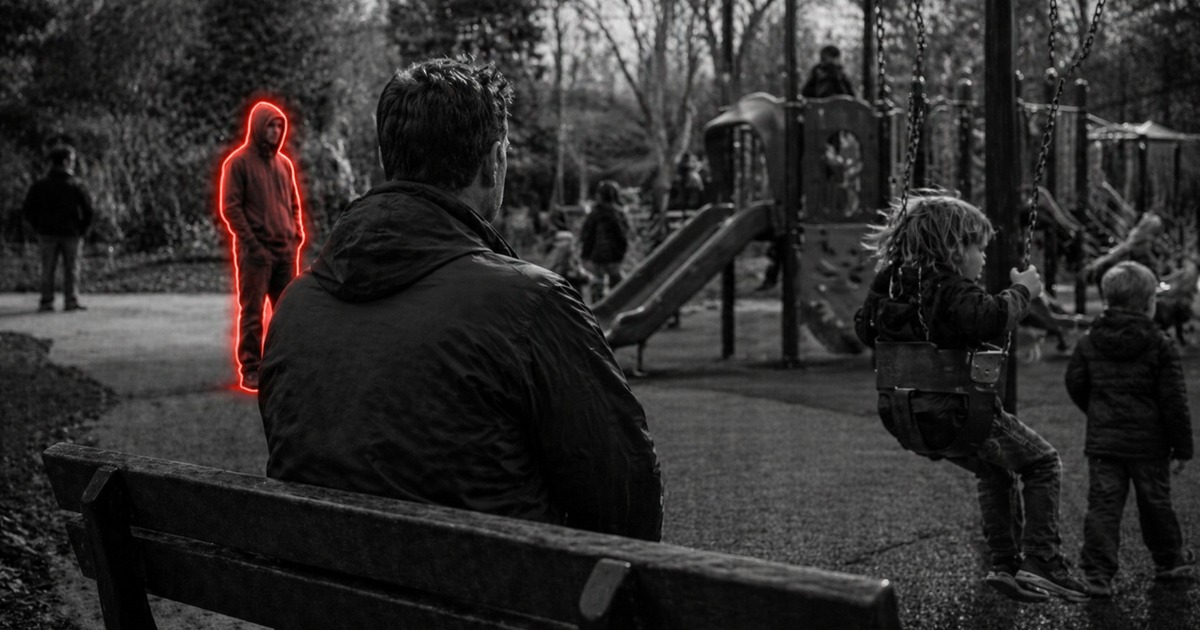
You are walking through a parking garage after work. A car idles near the stairwell with no one visible inside. A man stands between you and the elevator, checking his phone but glancing up every few seconds. The overhead light nearest your car is out.
Most people notice none of this. They are looking at their own phone, thinking about dinner, replaying a conversation from the office. They walk straight to their car and get in.
You can do better than that.
Forward thinking is the practice of reading your environment before anything goes wrong. Not paranoia. Not constant fear. A trained habit of noticing what is happening around you so you can make decisions early, when your options are still wide open.
This is one of the most important skills you will build in self-defense training. And it has nothing to do with throwing a punch.
What Normal Looks Like
Here is the principle that makes forward thinking work: you cannot spot what is wrong until you know what is right.
We call it baselining. Every environment has a pattern. A coffee shop at 7 a.m. has a rhythm. A parking lot at midnight has a different one. People move at predictable speeds, stand at predictable distances, behave in predictable ways.
When something breaks that pattern, you have information.
The first thirty seconds in any new space are the most important. That is when you build your baseline. Where are the exits? Who is here? What does normal look like in this place, at this time? Once you have that picture, anything that does not fit stands out.
A person standing still in a crowd that is moving. Someone watching you when everyone else is watching their own business. A door propped open that should be closed. These are not reasons to panic. They are reasons to pay attention.
The Entry Scan Habit
Forward thinking is not something you turn on when you feel threatened. By then, you are already behind. It is a five-second habit you install at every transition point in your day.
Every time you walk into a new space, you run a quick scan. Two exits. One barrier you could use for cover. One positioning adjustment that puts you closer to safety. Position solves problems that technique never has to.
This takes five seconds. You do it when you walk into a restaurant, a gas station, a grocery store, your kid’s school. After a few weeks of practice, it becomes invisible. You stop thinking about it. Your eyes just do it.
That is the goal. Not hypervigilance. Trained awareness that runs in the background while you live your life.
Cue Clusters, Not Single Signals
One thing that looks off is not a crisis. It might be nothing. A guy standing near your car could be waiting for someone. A person walking behind you could be going to the same store.
Forward thinking teaches you to watch for clusters. Two or more cues that converge on the same person or situation. A stranger closes distance while making eye contact. He positions himself between you and the exit. His hands stay hidden. That is not three coincidences. That is a pattern. And patterns are data you can act on.
The action does not have to be dramatic. You do not need certainty to take small protective steps. Cross the street. Change your pace. Walk toward a group of people or a well-lit storefront. Create distance. Early action is always low drama. That is the whole point.
Decision Triggers
Here is where forward thinking becomes more than observation. It becomes preparation.
We teach our students something called decision triggers. The idea is simple. Make your if/then decisions before you need them. “If someone approaches me at the ATM, I step to the side and create distance.” “If a stranger enters the elevator and I feel uneasy, I step out.”
You set these rules when you are calm, clear-headed, and rational. You execute them when things are moving fast and your heart rate is climbing. The decision was already made. All you have to do is follow through.
This matters because stress changes how your brain works. Under pressure, your options shrink. Complex thinking slows down. The decisions you have already made are the ones that survive. The ones you planned to figure out in the moment are the ones that stall.
Indecision is still a decision. It just costs more.
Safety Templates
Take decision triggers one step further and you get safety templates. A safety template is a pre-built protocol for a specific environment you visit regularly.
Your workplace parking lot. Your grocery store. The route you drive to pick up your kids. Each one gets three things. A baseline: what normal looks like here. A threshold: how many anomalies trigger action. A response: what you do when the threshold is reached.
You build these once. You update them when something changes. And because you built them in advance, you do not have to invent a plan under stress. The plan already exists. You just run it.
What This Looks Like in Training
At East Texas Krav Maga, forward thinking is not a separate class. It is built into how you train from your first day.
Scenario drills put you in realistic situations where you have to read the environment before you respond physically. Who is the threat? Where are the exits? Are there bystanders? Is there a weapon? These questions come before any technique. Because in real life, the person who reads the room first has the most options.
You also practice transitional awareness. Parking lots, stairwells, ATMs, elevators. These are the spaces where most attacks happen, because they are the spaces where most people stop paying attention. Your phone goes down. Your eyes come up. You scan before you move.
This is not about living in fear. It is about building a habit that gives you a head start when it matters.
Your Next Step
Forward thinking is a trainable skill. It is not a personality trait. It is not a gift. It is something you build through repetition, the same way you build any other capability.
If you want to start building it today, try this: for the next week, run a five-second entry scan every time you walk into a new space. Two exits. One barrier. One positioning adjustment. Write down what you notice at the end of each day.
You will be surprised how much you have been missing.
Schedule your free trial lesson at East Texas Krav Maga and start building the awareness and capability to protect yourself and the people you love.
[Not ready for a class yet? Download our free guide to situational awareness and start training your observation skills today.]


