Your Brain Needs a Shortcut
In Part 1, we talked about what happens to your thinking when stress hits. Your brain floods with adrenaline. Your working memory shrinks. The part of you that weighs options and thinks things through goes quiet, and you’re left standing there with a spinning wheel where a decision should be.
That’s not a character flaw. That’s biology. And the fix isn’t trying harder. The fix is thinking less in the moment by thinking more right now.
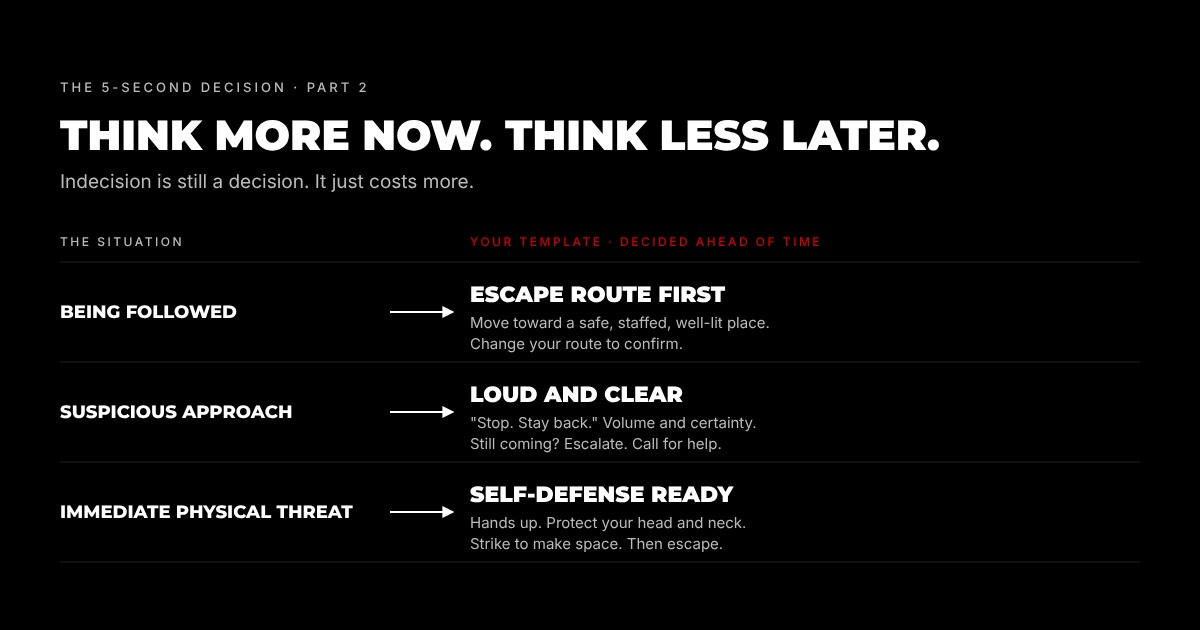
That’s what decision templates are for. A decision template is a pre-built response you’ve already chosen before the situation shows up. When the pressure hits, you don’t have to invent a plan. You just run the one you already have.
Indecision is still a decision. It just costs more.
Why Fewer Choices Mean Faster Action
Your brain can only hold so much at once. Psychologists call this cognitive load. On a normal day, you manage it fine. You compare prices at the store, pick a route to work, and decide what to have for dinner without breaking a sweat.
Under threat, that capacity drops hard. Your body shifts resources away from complex thinking and toward survival functions. Heart rate, breathing, muscle tension. The systems that keep you alive get priority. The system that weighs pros and cons does not.
If you haven’t pre-loaded a response, you end up stuck in a loop: “What do I do? What are my options? Is this really happening?” Those seconds add up. Research on stress and performance shows that a pre-loaded decision takes fractions of a second to execute, while an untrained decision takes full seconds. In a threat scenario, that gap is enormous.
Decision templates cut the loop short. You’ve already made the choice. All that’s left is action.
Three Templates That Work
These three templates cover the situations you’re most likely to face. Each one is simple enough to remember and apply even when your hands are shaking and your heart rate is through the roof.
Template 1: Escape Route First
Situation: You suspect someone is following you.
Template: Identify the nearest safe location, a crowded store, a staffed business, a well-lit area with other people. Move toward it. Change your route to confirm. If the person adjusts to match you, call for help or prepare to defend yourself.
Why it works: This template puts escape ahead of confrontation, which is almost always the safer play. You’re not waiting to find out if the person behind you is a threat. You’re moving toward safety while you figure it out.
Picture two people walking through the same parking structure. One has headphones in, head down, scrolling a phone. The other walks with head up, scanning, aware of exits and the people around them. The second person isn’t targeted at all. Not because they’re bigger or tougher, but because they’re clearly paying attention. The first step of Escape Route First is knowing where safety is. The second step is moving toward it before you’re forced to.
Early movement is cheaper than late heroics.
Template 2: Loud and Clear
Situation: Someone approaches you with suspicious intent.
Template: Use a loud, firm voice. Tell them to stop. Tell them to stay back. If they keep coming, escalate. Call for help. Prepare to defend yourself.
Why it works: Most people who mean you harm are counting on your silence. They expect you to freeze, look away, or try to be polite. A loud, clear command does two things at once. It sets a boundary with the person approaching, and it draws the attention of everyone nearby. Attackers don’t want witnesses. They don’t want scenes. Your voice is a tool, and volume is a weapon they aren’t expecting.
You don’t need a script. “Stop. Stay back.” is enough. The words matter less than the volume and the certainty behind them.
Template 3: Self-Defense Ready
Situation: You face an immediate physical threat.
Template: Get your hands up. Protect your head and neck. Use basic strikes to create distance. Escape the moment you have space.
Why it works: This template keeps your focus on two things: protect yourself and get out. Not winning. Not teaching someone a lesson. Protecting yourself long enough to create space, then using that space to leave.
The goal is never to stay and fight if you can leave. Every second you stay in a physical confrontation increases your risk. The template keeps your priorities in the right order: defense, space, escape.
How to Start Using These Today
Knowing these templates isn’t enough. You need to rehearse them until they feel automatic.
Here’s how to start:
Walk your daily routine in your head. Your commute, your parking lot, the path from your car to your front door. For each leg of that routine, ask yourself: which template applies here? Where would I go if I needed to move toward safety? What would I say if someone approached me? What would I do if I couldn’t get away?
Set a simple rule. Pre-load your decisions by setting rules before you need them. Something like: “Two things that don’t look right, and I leave.” You’re not being paranoid. You’re being prepared. The rule removes the debate in the moment. You already decided what would make you act.
Practice the physical pieces. If you train with us, you’ve already rehearsed defensive stances and basic strikes. Connect those skills to the templates. Know that when you run Template 3, your body already has the answers.
Every template here is built around one idea: distance doesn’t just keep you safe. It buys you time to decide. Create distance. Use that distance to think. Use that thinking to act.
What’s Next
You now have three decision templates you can use the next time your brain tells you something feels wrong. In Part 3, we’ll build the full mental playbook, four common threat scenarios mapped to specific responses you can rehearse and own.
Ready to Train These Skills in Person?
Reading about decision templates is a good start. Practicing them under pressure is what makes them stick. At East Texas Krav Maga, we build these patterns into every class so your body learns what your mind already knows.


