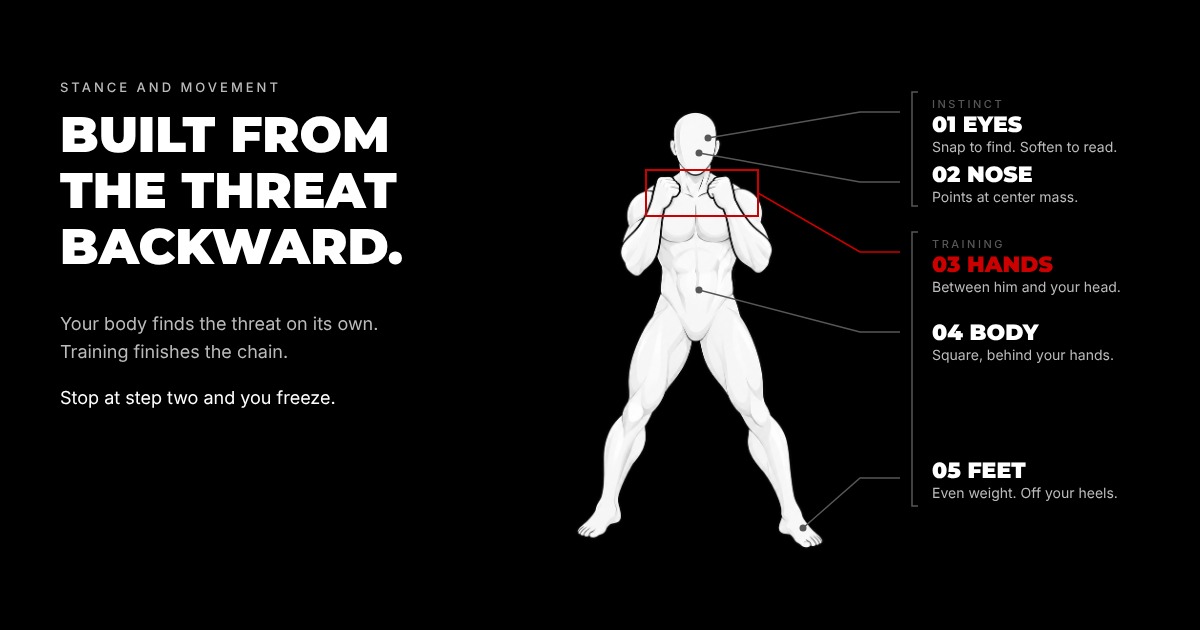
Something scary happens, and before you decide anything at all, your brain asks one question. Where is it coming from.
Your pupils open up to take in everything they can get. Your head snaps toward it. Your nose ends up pointed right at it, and that part is worth naming, because pointing your nose at the threat is what tells your mind there is a threat.
Nobody taught you that. You were born with it. It is old, it is fast, and it fires before thinking shows up.
Now look at what almost every school does with that. They teach the fighting stance from the feet up.
Your feet are not what is in danger. More than that, your feet are not what your body reaches for first. Your body goes to the threat.
So the order in this article is not something we invented. It is something we finish.
Your body hands you the first two steps for free. Eyes find it. Nose points at it. What it does not hand you is the rest, and for most people the chain stops right there. Startled, oriented, and then nothing. That is the freeze from the first article in this series, and it was never a character problem. It is a sequence that nobody ever finished.
Training puts the rest on the end of it. Hands between him and your head. Body behind your hands. Feet underneath holding all of it up.
Eyes, nose, hands, body, feet. Built from the threat backward, ending at the ground.
Your Eyes Find Him, Then They Settle
Two things happen here and the order matters, because they look like they contradict each other if you take them at the same time.
First the snap. Head turns, nose points, eyes go. Fast and hard, because you are locating something. This is not a decision and it does not have to be taught. It is worth knowing anyway. A person who understands what their body just did on its own is far less likely to feel like they lost control of it.
Then the settle. Once you have found him, the hard look is over, and it has to be. A hard stare is target fixation, and fixation makes you slower instead of faster.
What you settle into is a relaxed gaze near the middle of his chest. We call it the chilled out gaze.
Snap to find him. Soften to read him. Two different jobs, and your eyes do both, one after the other.
Here is what you are reading once you soften. His shoulders and his hips, because they tell you what the rest of him is about to do. And his hands, always, because his hands are what will hurt you. Nothing else on him can.
Your chin and your shoulders belong with your head, so build them here. Chin tucked slightly. Shoulders shrugged up slightly. That combination protects your jawline and your neck, and it never turns into a hunch. It is part of the position, not one more thing to remember.
It is the middle of him from any angle. Facing him, beside him, behind him, above him, below him. Wherever you are, your nose and your attention go to center mass. That never changes. It is the same instinct from the opening of this article, only now you are aiming it on purpose instead of by reflex.
There is a physical reason the soft version beats the hard one. Stress already narrows what you can see. Your pupils opened up to take in more, and then a hard stare throws that away and hands it back. Widening on purpose is how you keep seeing his hands, the second person off to your left, and the door.
Your Hands Go Where Your Eyes Went
This is where training takes over from instinct, and saying that out loud is the point of this heading. Your body located him on its own. It will not put your hands up on its own. That part gets built.
Start with the reason, because the reason is the whole article.
You are protecting your brain. Your computer. Your consciousness. That is the highest value thing you have, and the moment you lose it, everything that happens next belongs to somebody else. It gets decided by their ethics, their morals, and their values.
Everything below is in service of that one thing.
So your hands go where your eyes went. Wherever your nose is pointed, your hands get between that and your head.
Getting there is a little unusual, and it is easier to do than to read. Reach both hands over your head. Now drop your elbows straight down to your sides, to your liver and your spleen, and let your palms stay up and forward. That is the position. We call it holstering your weapons, and it looks exactly like that.
The finished shape is simple. Hands above and forward of your elbows. Open, not clenched. Ready, not rigid.
Notice what this position also does. At low volume it reads as a man talking with his hands, because that is what it looks like. It is not something you assume when trouble starts, which is the only reason you will ever actually use it.
Your Body Backs Your Hands
Short idea, and an important one.
Your shoulders face where your eyes face. Your palms face the same way.
Arms held out in front of you are not structure. Structure is your whole body standing behind your hands. Whatever your hands are doing, the rest of you is supporting it.
That is the difference between a hand that stops something and a hand that gets pushed through.
Your Feet Arrive Last and Hold It All Up
Feet just outside shoulder width. Your dominant leg sits slightly behind your lead foot.
Everything in this article is written right handed, so if you are left handed, mirror it.
Now the correction that matters most, and it needs to be said plainly. Your hips are square and your body is square. This is not a bladed stance. You have seen bladed stances online and you will default to one unless somebody tells you otherwise.
Square is what keeps both of your hands in the fight and lets you move any direction without turning first.
Here is the part that sounds like it cannot be true. Your feet are staggered and your hips are still square.
Both are true at once, and you can prove it standing where you are. Slide one foot back a few inches. Your hips did not have to turn to let that happen. The stagger is front to back. The square is side to side. They are two different things and they live together fine.
Your weight rides on the balls of your feet. Your heels stay light. Never dug in.
Front to back it is even. Fifty on your lead foot, fifty on your rear foot. If you have seen other systems, you may be expecting most of it on one leg. Not here. Even weight is what lets you move either direction without shifting first.
Then the self-correction, and this is the one thing to take out of this article and use.
When you feel your weight drift back into your heels, bring your hands, your head, and your shoulders forward. The weight comes off your heels on its own. Add a small movement off the line while it happens, which is where the next series picks up.
The mat cue is four words. Off your heels and move.
Those look like two instructions and they are one. When a student is sitting on their heels, they are almost never moving. The heels are not really the problem. Being stuck is the problem, and the heels are what tell you it is happening. So the fix is not stand differently. The fix is go somewhere.
Breathe, and Never Be Still
Breathe as calmly as you can get it.
The reason is practical and not spiritual. A lower heart rate leaves you able to think, and thinking is the thing you are protecting. A slow exhale is the fastest tool you have for that, and it is available to you at any moment, in any room, with nobody knowing you are doing it.
If your hands shake the first few times you build this, that is physiology and not character. It happens to people who have done this for years. It is your body handing you fuel, and it settles as the position becomes familiar.
Last piece. You are never still.
A still person is easy to hit, and a still person cannot move fast. So you are always slightly moving, even standing in a hallway having a conversation. Small, quiet, nothing anyone would notice.
Think of an air hockey puck. It floats anywhere it needs to go. It bounces off contact instead of absorbing it. And it takes a lot to knock it off its base.
That is what you are building. Not a rock. A puck.
Training Saves Lives
You just built a position out of words on a screen.
Here is the honest part. You have no way to know whether you built it right.
Your hips might be turned three inches more than you think. Your heels might be carrying weight you cannot feel yet, because nobody has ever asked you to notice it. Your shoulders might be up around your ears instead of shrugged slightly. Every one of those is a two second fix in a room, and none of them is a fix you can make from a page.
Reading a stance and having somebody put eyes on yours are different things.
Attend a free trial class in Tyler. Build it once with someone watching, and it stops being a description and starts being yours.
Not ready to walk in yet? Download the free Self-Defense Starter Guide and work the pieces you can practice on your own.


