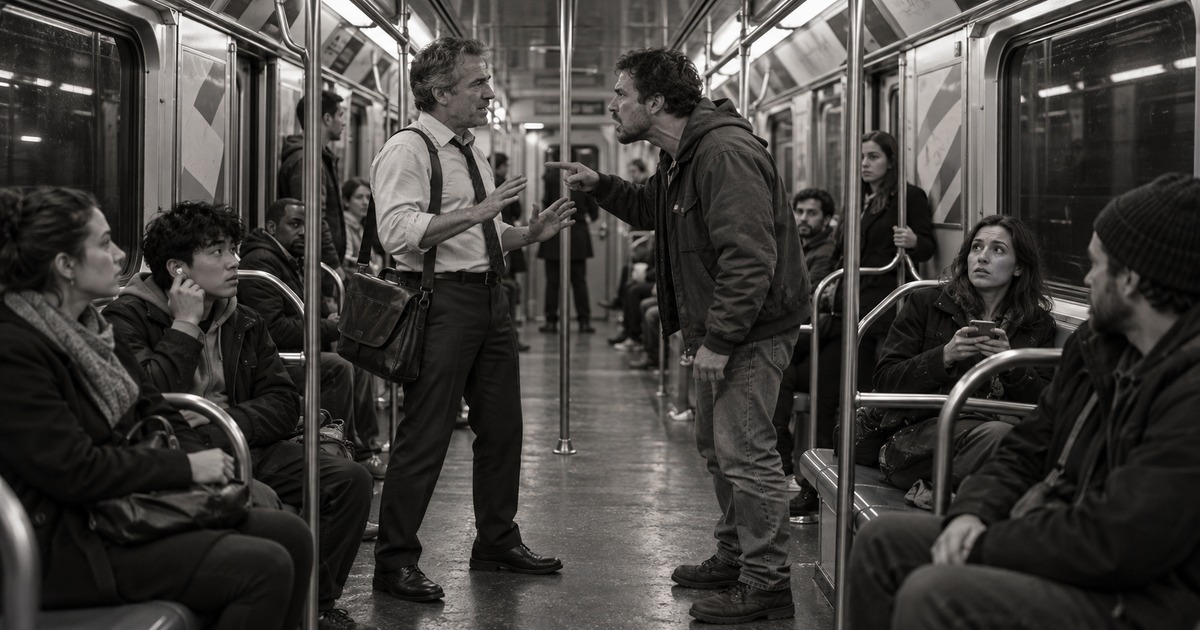
A man is upset with you and nobody has done anything yet.
You have probably handled that two ways. You went along with him and hoped it would burn itself out. Or you met him where he was and held your ground.
Both of those hand the outcome to him.
There is a third way, and it is the one people who deal with upset strangers all day actually use. Nothing about it is clever. It is a way of standing, a way of talking, and a way of moving, and all three run at the same time.
Something Is Wrong and Nobody Has Touched Anybody
Start with the version you are most likely to get.
Somebody is upset. A customer at your counter. A parent at the office window. A neighbor, or a man in a parking lot who thinks you did something to him. Nothing has happened. It is not violence and it may never be.
By the definition from the last article, you are already in it.
That sounds like it should raise your heart rate, and it does the opposite. Your mind is engaged. Your position is already correct. Nothing has to be decided in a hurry, because you did not lose the first second finding out you were in something. Being in it early is exactly what buys you the calm.
So here is the frame for everything below.
You are not looking for a way to win, and you are not looking for a way out. You are looking for the solution that is good for everybody, and that includes him. A man who ends up better off stops being a problem. It is kind, and that is not why you do it. It is the fastest way to end the thing you are standing in.
How the People Who Do This All Day Handle It
Police officers and private security make contact with strangers for a living. Most of those contacts never become a fight. Not most days. Most contacts.
They still arrive ready. They also arrive without deciding in advance that the person in front of them is an enemy. Make contact. Find out what is actually happening. Control it only if the situation demands it, and usually it does not.
Pull one thing out of that and it is this. Ready and hostile are not the same thing.
Almost everybody treats them as the same thing, which is why most people only have two settings. Unprepared, or aggressive, with nothing in between. There is a wide middle, and nearly every real encounter lives in it.
We teach this to school security teams, church security teams, law enforcement officers, and every student who walks in the door at ETKM. It works in a squad car and it works at a front desk, for the same reasons.
You Have the Same Problem Without the Badge
You are not on duty and you never will be. The encounter is the same anyway.
The person at your door who will not say why he is there. The man crossing a parking lot toward you at night. The customer coming apart in front of a line of people. The family member who has had too much at a gathering and is looking for somebody to have it out with.
Two of them happen constantly, and neither one involves anybody who came looking for a fight.
A parent shows up at a school angry about something that happened to his kid, and an administrator is standing in front of him in the office with the front desk watching. Or a patient’s family member in an emergency room has stopped being reasonable, because he has been awake for nineteen hours and nobody will tell him anything.
Those are ordinary workplaces. Church volunteers, school staff, front desk people, nurses, and the man who was handed a security shirt and no instruction. If that is your week, this is your article.
In every setting there are going to be different social rules, and you know yours better than anybody writing about them. What you can do in a parking lot at ten at night is not what you can do in a school office with a line of people watching, and neither one is an emergency room where staff and security have procedures of their own. The technique does not change. What changes is how much room you have to use it and what reads as normal in that room.
Here is the part that does not carry over.
An officer has authority to direct people. You do not. Not on your porch, not at your counter, not anywhere. The second a civilian starts giving orders to a stranger by right, he has built the exact fight this article exists to prevent. What carries over is the mentality and the position. Never the authority.
Your Words Are Steering Him Whether You Meant Them To or Not
Say the plain thing first, because this is where most advice falls apart.
Your communication directs him.
You are not being nice and you are not hoping he settles down. You are steering, on purpose, toward an outcome you already picked.
It sounds like this. If I were in your situation I would be upset too. What got you here.
That is two sentences, and there is no script underneath them. Memorizing lines is not the skill.
It works for one reason, and the reason is not the wording. It works because it is true. Deliver it as a technique and he will feel handled inside a second, and being handled escalates a man faster than being argued with. He can tell. Everybody can tell.
So the work is not learning the sentence. The work is actually spending thirty seconds on the possibility that he has a reason. Most of them do. It is rarely a good enough reason, and that is not the point.
Something else is happening while you ask. Watching a man runs out. There is a limit to what standing there reading him will tell you, and a small action tells you the rest. Asking what got him here is that action. You find out who you are dealing with by engaging him.
What comes back may not match what you assumed when you walked up. Change your read. Hasard Lee calls that updating without ego, and it costs you a second. Being wrong about him early is not a failure. Staying wrong about him is.
Then there is the sentence that does more work than any other one here.
Nobody here needs to know about your business.
He will hear that as a gift, because it is one. It hands him a way to leave that is not surrender. Most men in that moment are not fighting you, they are fighting the room, because backing down in front of people costs something real. Take the audience out of it and the cost goes away. A man who does not have to lose in front of a room is a man who can walk, and most of them will if you let them.
The full set of verbal skills is its own subject, and it is coming in its own series.
Ready Should Look Like an Ordinary Conversation
Your hands are above and forward of your elbows.
At this volume that is the whole thing. It looks like a man talking with his hands, because that is what it is. It reads as normal to him and it reads as normal to everyone watching, and that second part matters more than it sounds.
The last article said a stance you assume when trouble starts is assumed too late. Here is what that costs in a room with a live person. Assuming it is itself an escalation. He watches you square up, and now he has to answer that, and you built the thing you were trying to prevent.
A position that costs you nothing socially is the only position you will ever actually hold. That is not a compromise. That is the entire reason it works.
From there you can cover, you can block, and you can send. None of that is taught here. It is named so you understand the position is not decorative.
No eyes, no feet, no weight. That is the next series.
Move the Conversation Somewhere Better
This is the technique, and it is one technique rather than two things happening near each other.
The words alone are only a conversation. The movement alone is a stranger steering a man who never agreed to be steered, and nothing in this article escalates faster than that.
The words do three jobs.
They empathize, honestly. They hand him an exit that does not cost him face. And they propose somewhere better, asked as a question instead of given as an instruction.
Let us go somewhere quiet where we can actually communicate. Is there a quiet place outside. Is there an office nearby we can chat in.
Asking is not softness. Asking gives him a choice, and a man who chooses to walk is walking on his own terms. Told to walk, he is a man being removed in front of people. Same door, different event.
What got you here comes once you are moving, or once you have arrived. Not while a room is watching him.
The movement runs at the same time.
Your lead hand goes to the back of his elbow. That is the checking hand doing its ordinary job, feeling pressure and telling you what he is about to do before he does it. Your dominant hand points the direction the two of you are going.
You come off his front. You move to his side, then behind, off his strong line and away from where a weapon would come from. You walk behind him and guide. You give him space instead of taking it. Everything stays calm and unhurried, because hurry is a message too.
Guiding them respectfully and calmly to a place that is safer for everybody. That is the whole description of it.
How much contact, and for how long, is not fixed. It depends on the situation and on him. Do you need to control him out the door, or is he walking on his own. How aggressive is he. How compliant is he.
The honest default is that once he is in front of you and moving, you probably are not touching him at all.
That is the tell. If they allow me to be behind them, walking behind them, they have established trust with me. That trust is what you were working for the whole time, and it is worth more than any grip.
Which inverts what most people expect. Contact is not the goal. Holding on is not what makes this work. The hand is there while compliance is uncertain, and it comes off when it is not. You are not breaking contact as a move. You are reading whether contact is still doing anything.
Now the part worth explaining instead of assuming.
Pointing reads to him as direction and as courtesy, and it commits that hand to nothing at all. It stays free to strike, free to control, and free to reach for something else entirely if the category changes. So the technique buys the whole de-escalation and spends nothing on your safety.
That is the line in the sand from the last article, standing up and walking around. You are steering him toward an outcome that is good for both of you, and you are still positioned for the thing you already decided you would do.
Nothing inverted to make that happen. The lead hand is the checking hand at every volume. The dominant hand does the work at every volume. Pointing is only what the dominant hand happens to be doing right now. It is the same structure the next series builds piece by piece, running here at volume one.
He will not always say yes, and you are already asking about it.
That answer belongs to the de-escalation series and it is not taught here. One sentence about it earns its place anyway, because it is the strongest argument for everything above.
If he refuses, nothing has gone wrong for you. Your feet are already where they should be. Your hands are already where they should be. Your mind was engaged before he opened his mouth. You are not caught off guard, because there was never a second where you were not ready.
That is what all of it was for.
Two people walked outside. Nobody got hurt. He said his piece somewhere he could actually be heard. And you were never out of position for a second.
Training Saves Lives
Read all that back and notice something about it. You are already doing this work.
You talk people down at a counter. You stand between an upset parent and a room full of kids. You take the call from the family member who is coming apart. Nobody ever trained you for any of it, and you have been handling it anyway.
Here is the gap.
Everything above is a decision, and a decision you have never trained is a sentence. Your hands do not know where to go. Your feet do not know how to come off his front while your mouth keeps working. Under pressure you will not rise to what you read. You will run what you rehearsed.
That part cannot be read into place. It gets walked through with another person, slowly, until it belongs to you.
Attend a free trial class in Tyler. Bring the worst one you have handled and we will work it standing up.
Not ready to walk in yet? Download the free Self-Defense Starter Guide and start with what you can practice on your own.


