You’ve been told to avoid conflict. You’ve also been told not to be a victim.
Nobody ever told you which one is running right now.
So you carry both of them around, and they cancel each other out at the exact moment you need one of them to be louder. That gap is where people freeze, and it isn’t because they didn’t care enough or didn’t want it badly enough. It’s because they were handed two rules and no way to pick between them.
Noticing something was the last article. This one is the question that comes right after it. Fine. I noticed. Now what.
An Altercation Starts Before Anybody Touches Anybody
Picture the common version, because it’s the one you’re most likely to get.
A disagreement. Somebody upset with you at a counter. A man in a parking lot who thinks you cut him off. A family gathering where the volume climbed and it isn’t coming back down on its own. Nothing has happened. Nobody has touched anybody.
Not every altercation looks like that, and it would be dishonest to write this without saying so. Some of them start with a hand already on you. An ambush gives you no verbal phase at all. There’s no talking, no reading him, no chance to steer anything, because by the time you know it’s happening you’re already well behind the curve.
That’s a real category and it isn’t the one this article is about. This one is about the altercation that hasn’t turned violent yet and could. The kind where words are still available and the outcome is still open.
If you’ve been through the other kind, you didn’t handle yours wrong. You were handed a different problem with less warning.
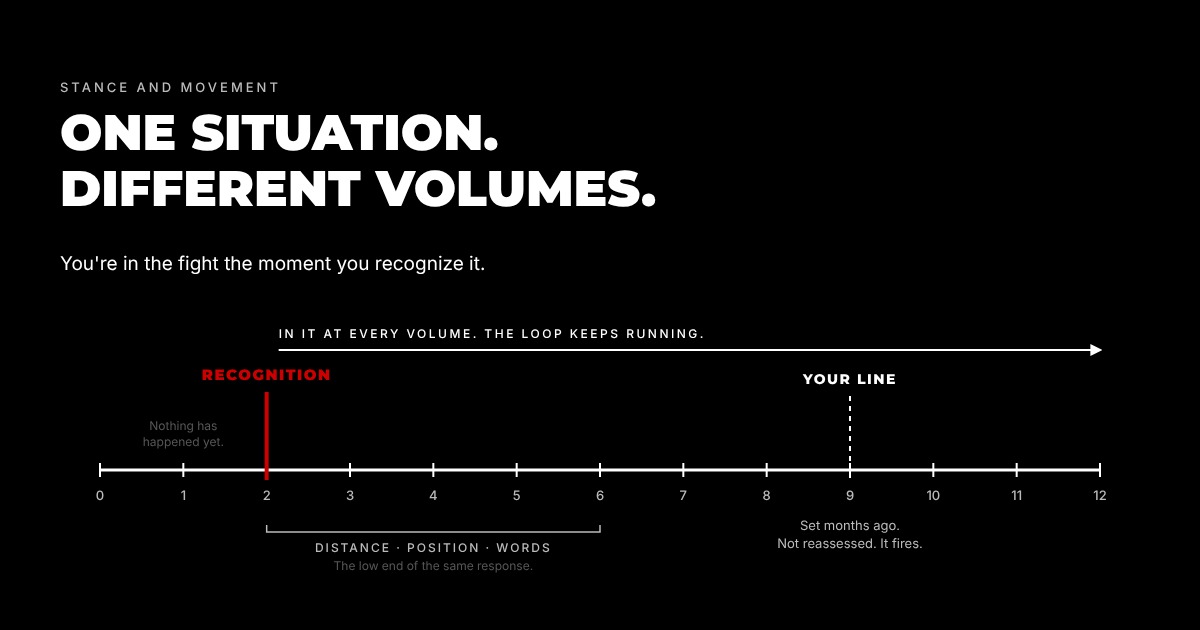
Here’s what makes both of them one thing. You are in the fight the moment you recognize you’re in an altercation. That’s true whether recognition shows up three minutes early or three tenths of a second late. Nothing about it depends on having time. What time changes is how much room you have to work with.
Which is exactly why awareness came first. Awareness is what buys recognition earlier, and every second you move recognition forward is a second of options you didn’t have before. It’s also what turns an ambush into an altercation you can still work.
What to do when recognition comes late and he’s already coming at you is later in this series, and it starts with moving instead of talking.
For now, the plain version. In an altercation that hasn’t turned violent, you are already in it.
That is not as aggressive as it sounds. Being in it doesn’t mean fighting. It means the situation has your attention and you’re working it. Your mind is engaged, your position is chosen, and you’re reading him. That’s all it means.
The alternative is worse, and you already know it. If you decide you’re in it only once he swings, you’ve handed him the first move and the first second. Those are the two things you don’t get back.
Your Mind Commits Before Anything Physical Happens
Something is running the whole time you’re standing there, and it’s worth knowing what it is.
You’re watching him. You’re making sense of what you’re watching, and you’re doing that off what you trained instead of off guesswork. You decide off training too. Then you act, and you act all the way instead of halfway. Then it starts over, because he changed something and now you’re reading the new thing.
That last part is the point. It doesn’t run once. It keeps running the entire time, at every volume, which is another way of saying the fight started when you recognized it.
We call it OODA. Observe, orient, decide, act. A fighter pilot named John Boyd put those four words together, and the deeper work on it comes later in your training.
There’s a second piece that sits next to the loop, and it works the opposite way.
A pre-committed default is a decision you made months ago that doesn’t get reassessed. It’s fixed on purpose. If this specific thing happens, I do this, and I don’t spend a single second deciding whether it counts.
You need both, and here’s why. The loop handles everything that changes by degree. The default handles the thing that changes the category. Without a fixed line, the loop can talk you right through a threshold, because reassessing is exactly what a loop does.
Picture a custody argument in a church hallway. You’re doing everything right. You’re reading him, you’re steady, the words are working and the volume is coming down. Then you see the grip of a handgun above his waistband.
That is not something to reassess. That’s a line you set months ago, and the response fires.
You do not have to get punched first in order to defend yourself and take action.
That sentence is what makes a fixed line legitimate instead of aggressive. It’s permission to act on what you actually saw. It is not permission to go early.
So write one down. One line, for the place you’re in most, set while you’re calm and nothing is happening. Same kitchen table, another ten minutes. A line decided during the situation isn’t a default. It’s a guess wearing the word.
Talking Is Not What You Do Until the Real Thing Starts
Most people file talking under avoiding. Something you do because you’d rather not do the other thing.
That’s backwards, and it’s expensive.
Distance, position, and words change a situation far more than they cost you. That makes them the highest value options on the board, not the polite ones. Reaching for them first isn’t hesitation. It’s using leverage while you still have some.
There’s a second reason they get skipped. Under pressure your mind collapses down to two choices, fight or run, and both of them are usually bad. They show up because pressure narrows what you can see, not because they’re the only two that exist. The trained answer is to find a third one before you commit to either. Most of the time that third one is the one that works.
People who use force for a living describe their options as a continuum. Not a ladder. It’s a range you enter at whatever level the situation is already sitting at, not a set of steps you climb in order. The part that matters for you is where presence and verbal direction sit in it. They’re inside the force response, not out in front of it waiting their turn. Talking isn’t the preamble to the real thing. It’s the low end of the same thing.
None of that means a person has to work up through anything while being assaulted. That’s a framework for people operating under agency policy. You’re not on duty.
There Is One Situation Running at Different Volumes
Call it volume zero to volume twelve. One situation getting louder, not two situations with a line drawn between them.
That’s why nothing about you has to change when the volume rises. Your mind is already engaged. Your position already works. There’s no switch to throw and no gear to go find.
It matters more than it sounds. A stance you assume when trouble starts is a stance you assume too late, because assuming it is itself an escalation. Most people will not do that in front of another human being, and they’re not wrong about the cost of it. A position that reads as ordinary conversation is one you’ll actually hold.
We’re not describing that position here. It’s coming in the next series. All you need right now is that it exists and it doesn’t change.
What it looks like in practice is maintaining control. You’re reading change as it happens, in his behavior, his mood, his tone, his actions, and you’re working through the shift instead of reacting to it. The loop is what makes that possible, because it never stopped running.
Going Home Is the Win, and Some Days He Goes Home Too
Leave your ego out of it.
Somebody takes the parking spot you were waiting on, let them have it. Somebody calls you a name, that’s theirs to carry, not yours. Let it go off your back like water off a duck’s back. None of that is worth a thing, and none of it is a fight you’re required to attend.
Now the other side of it, said just as plainly. An argument is not an assault. When someone imposes violence on you, the choice to walk away is not on the table anymore, and that is a completely different decision.
Going home is the goal. That part is easy to agree with.
Here’s the part worth saying out loud. When he goes home too, because you kept it from turning into a fight, you didn’t just avoid something. You assisted him. He doesn’t get hurt. He doesn’t get arrested. He doesn’t lose whatever he was about to lose in the next ten minutes.
That’s a win on both sides of it. Plenty of places treat talking as the delay before the good part. It isn’t a delay. It’s the best outcome on the board, and you’re the one who produced it.
Training Saves Lives
You’ve got a line to write down now. That costs you a notepad and ten quiet minutes, and it’s yours to do tonight.
Here’s what the notepad can’t do for you.
A line you’ve never trained is a sentence. It reads well and it means nothing at the second it’s supposed to fire, because your body has no idea what to do with it. Training is what turns a sentence into a response.
That’s the whole difference between a person who decided something and a person who can hold it. Not nerve. Not size. Reps.
Attend a free trial class in Tyler. Bring the line you wrote and find out what it takes to hold it.
Not ready to walk in yet? Download the free Self-Defense Starter Guide and keep working the quiet end.


