Reverse Engineering Self Defense Blog Series: 3 of 8
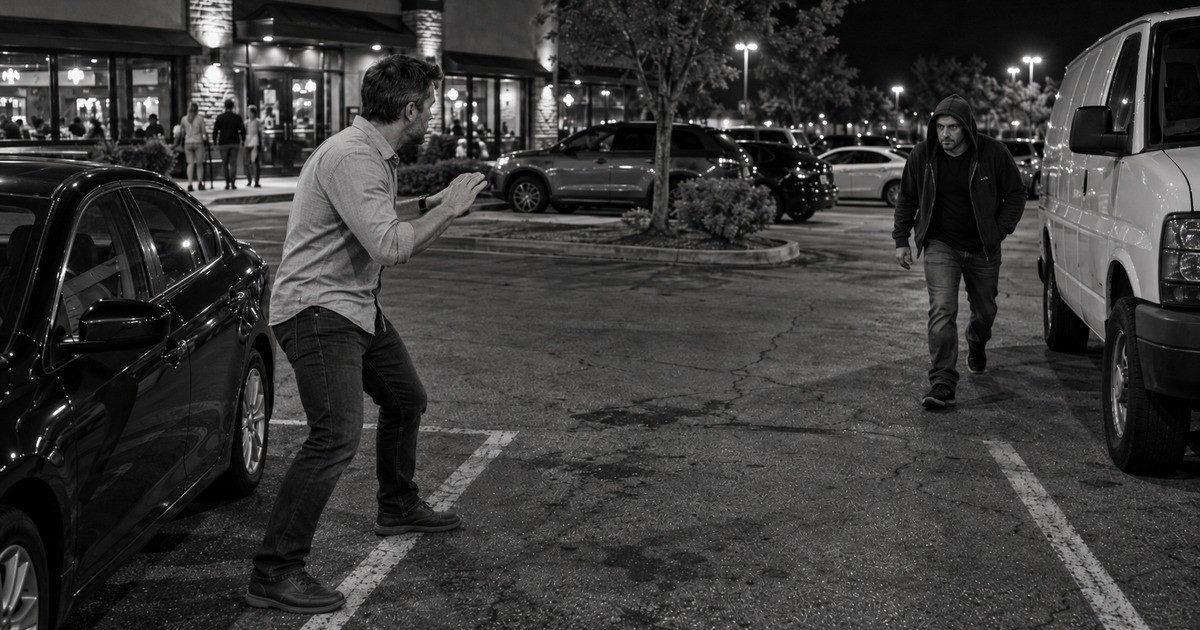
Picture this. You are walking to your car after dinner. A man steps out from behind a van, closes the distance fast, and grabs your jacket. The whole thing takes about two seconds.
In those two seconds, your heart rate spikes past 150 beats per minute. Your hands go cold. Your vision narrows. The part of your brain that handles creative problem-solving shuts down. You are not thinking anymore. You are reacting, and you will react with whatever your body has been trained to do.
If you have never trained, your body defaults to freezing. Not because you are a coward. Because your brain has no file to pull from. No rehearsed response. No decision already made. So it waits. And while it waits, the situation gets worse.
This is the problem that Krav Maga is built to solve.
What Stress Actually Does to You
Most people imagine that in a crisis, they will stay calm, think clearly, and do the right thing. The research says otherwise.
When your heart rate climbs above 115 beats per minute, your fine motor skills begin to degrade. The precision you need for small, coordinated movements starts to disappear. Above 175 beats per minute, complex motor skills and higher-level thinking become unreliable. Your body is flooding with adrenaline, and your nervous system is routing all available resources toward the simplest, most deeply conditioned behaviors it can find.
This means the fancy technique that looks great at slow speed in a calm environment may not be there when you need it. What does survive? Gross-motor movements. Large muscle, simple mechanics. A palm strike. An elbow. A knee. A shove to create distance. These are the techniques that your body can still access when your brain is running on backup power.
This is why Krav Maga is built around gross-motor responses. Not because simple techniques are all we teach. Because simple techniques are what actually work when you are terrified.
The First Second Decides Everything
Most people assume that reaction time is about how fast your hands move. It is not. The majority of delay in a crisis happens upstream, in the gap between detecting the threat and deciding what to do about it.
Here is how that gap breaks down. First, you detect: “What is happening?” Under stress, your perception may be narrowed. Threat cues that would be obvious at rest may register late or not at all. Second, you decide: “What do I do?” This is where most time is lost. An untrained decision under surprise takes seconds. A pre-loaded decision, one that was made before the event, takes fractions of a second. Third, you act: “Execute the response.” This is the part people think of as reaction time, but it is actually the smallest portion of the total delay. The body moves quickly when the brain has already decided. The body hesitates when the brain is still deciding.
This is why we train the first action, not just the combination. Get the first movement right and everything changes. If your body fires one immediate response the instant something happens, you break the attacker’s timing. That buys you the seconds you need for everything else.
That first action does not need to be perfect. It needs to be immediate. Movement is life. Action breeds action. Freezing breeds freezing.
How Training Closes the Gap
Knowing all of this is useful. But knowing does not transfer to performance. The only thing that transfers is conditioned response, and conditioned response requires specific types of training.
The first layer is volume. You practice the same gross-motor responses hundreds and then thousands of times until the movement is automatic. Not understood. Automatic. There is a real difference. A technique you understand requires thought to access. A technique that is automatic fires without thought. Under stress, only the automatic ones show up.
The second layer is stress inoculation. This is where training starts to feel different from a normal workout. We add surprise elements, time pressure, physical fatigue, noise, and distraction. Not to make training harder for its own sake. To close the gap between calm performance and what happens when your nervous system is on fire. Students who only train in controlled conditions perform well in controlled conditions. The real world is not controlled.
The third layer is decision pre-loading. Before every scenario drill, you set your if-then rules. “If someone grabs me from behind, I drop my weight and fire elbows.” “If someone closes distance aggressively, I create space with a palm strike and move toward an exit.” These are not hypothetical. You rehearse them with a partner, with a random start cue, under pressure. When the moment arrives for real, the decision is already made. You do not have to think. You act.
Your autopilot runs the program you installed in training. The question is whether you installed the right one.
Disrupt, Create Space, Get Out
The goal of responding to a sudden attack is not to win a fight. It is to survive it. And surviving it means disrupting the attacker’s plan, creating enough space to regain your options, and getting out.
Disruption is the first job. An attacker who grabs you expects you to pull away. They do not expect an immediate, aggressive counter. An elbow to the ribs. A knee to the thigh. A palm strike to the face. These are not finishing moves. They are interruptions. They break the attacker’s grip on the situation for one or two seconds, and those seconds are everything.
Creating space is the second job. Once you have disrupted the initial attack, you need distance. Shove off. Step back. Angle toward an exit or toward other people. Distance restores your options. It gives you time to see what is happening, decide whether to continue fighting or run, and move toward safety.
Escape is the third job and the most important one. Every technique we train includes an exit strategy. The point is never to stay and exchange blows. The point is to create a window and use it. The best outcome is the one where you are somewhere else. Safe. Home.
You Do Not Rise to the Occasion
There is a phrase we come back to often in training: you do not rise to the occasion. You fall to your level of training. On a good day, you might perform a little above your baseline. On a bad day, you will perform below it. But your baseline is set by what you have actually practiced, under realistic conditions, with enough repetition that the response is automatic.
That is what this kind of training builds. Not confidence based on hope. Confidence based on evidence. You have done this drill a hundred times. You have done it tired. You have done it surprised. You know what your body does when the pressure arrives. You have been there before, in training, where the stakes are low enough to learn and high enough to condition.
If you want to build that kind of readiness, come train with us. Your first class at East Texas Krav Maga is free. Show up, work through a real class, and see how your body responds to training designed for what actually happens in a crisis.
Schedule Your Free Trial Class at East Texas Krav Maga
Want to learn more first? Download our free guide to self-defense readiness and start building your baseline today.


