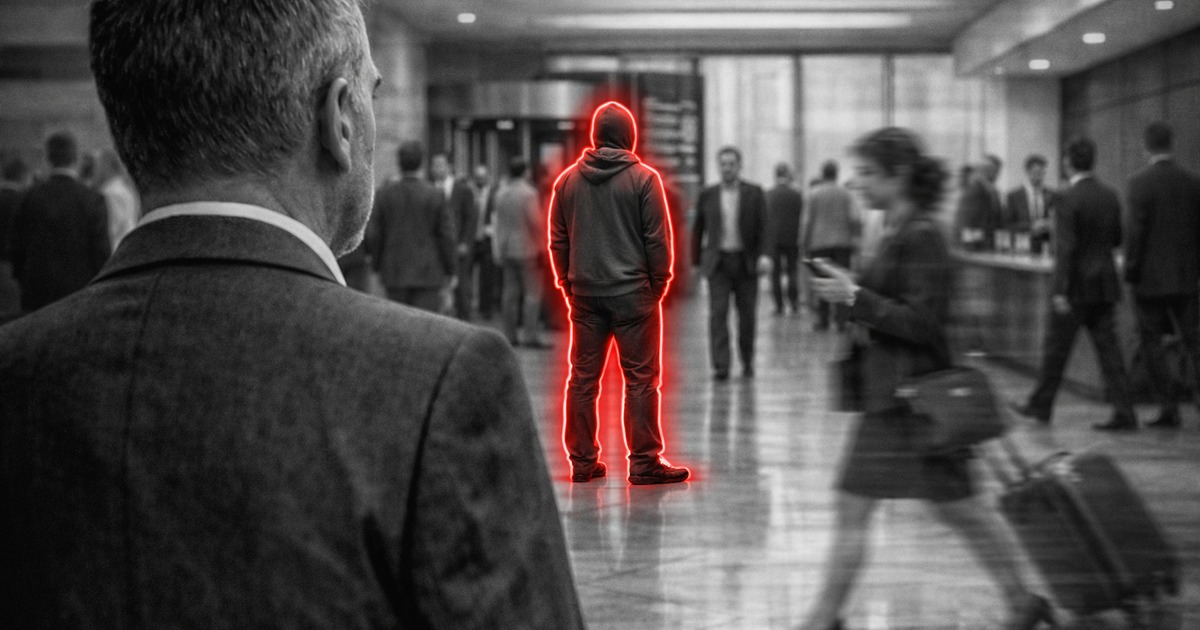
In military language, the “bang” is the event. The explosion. The ambush. The moment violence starts. Everything before that moment is “left of bang.” Everything after it is “right of bang.”
Patrick Van Horne and Jason Riley wrote an entire book about this concept, and the title says it all: Left of Bang. Their argument is simple. If you can read the environment and the people in it well enough, you can detect threats before they become violent. You don’t react to the explosion. You see the person planting it.
Most self-defense training focuses on what to do right of bang. Someone grabs you. Someone swings at you. Someone pulls a weapon. You respond. That training matters. But if that’s all you have, you’re always responding to someone else’s plan. You’re always a step behind.
Being left of bang means you saw the threat forming before the person acted on it. You noticed the behavior that didn’t fit. You read the signals and made a decision while you still had options. That’s a different kind of readiness, and it’s one of the most important things you can train.
At East Texas Krav Maga, we train both sides of the timeline. We teach you what to do when violence happens. And we teach you how to see it coming so you can prevent it, avoid it, or prepare for it before your options disappear.
The Six Behavioral Domains
Van Horne and Riley break human behavior into six domains. Each one gives you a different lens for reading what’s happening around you. When you learn to observe through all six, you start seeing patterns that most people miss entirely.
Kinesics (Body Language)
This is the most intuitive domain. You already read body language every day, you just don’t do it consciously under stress. Kinesics is about watching how people move, how they hold themselves, and what their posture tells you about their intent.
A person clenching their fists while talking to you is telling you something their words aren’t. Someone scanning exits while standing near you is telling you something. A person whose facial expressions don’t match what they’re saying is telling you something. Learn to read those signals the same way you’d read a weather forecast before heading outside.
Biometrics (Bodily Responses)
This domain focuses on the physiological responses people can’t fully control. Sweating when it’s not hot. Rapid breathing when nothing physical is happening. Flushed skin, dilated pupils, a voice that suddenly changes pitch.
These responses are driven by the autonomic nervous system. A person gearing up for violence is experiencing an adrenaline dump, and that dump produces visible signs. They can control their words. They can’t control their sweat glands.
Proxemics (Use of Space)
How people position themselves relative to others reveals a lot. Someone closing distance with you when there’s no reason to be closer is a signal. Someone positioning themselves between you and the exit is a signal. A person who maintains a specific distance from security while angling toward a target is a signal.
Proxemics also tells you about group dynamics. People who are together behave differently in space than people who are alone. When someone appears to be alone but their spatial behavior suggests coordination with others, that’s an anomaly worth noting.
Geographics (Environmental Relationships)
This domain asks a simple question: does this person belong here? Not in a judgmental sense, but in a behavioral one. A person wandering through a school hallway with no clear purpose at 2 pm on a Tuesday looks different than a parent picking up a child. A person sitting in a parked car in a residential neighborhood for 40 minutes without getting out or making a call looks different than someone waiting for a friend.
Geographics is about understanding what normal behavior looks like in a specific environment and noticing when someone’s relationship to that environment doesn’t fit.
Iconography (Symbols and Signals)
What people wear, carry, and display communicates affiliation, intent, and identity. This can be as obvious as gang-related clothing or as subtle as a person overdressing for an environment in a way that suggests concealment.
Iconography isn’t about profiling. It’s about reading signals that people broadcast, intentionally or not, and processing them alongside everything else you’re observing.
Atmospherics (The Mood of a Place)
This is the domain most people feel but can’t name. You walk into a bar and something feels off. A neighborhood that’s usually noisy is suddenly quiet. A crowd that was moving freely is now still.
Atmospherics is your read on the collective energy of an environment. When the mood shifts, something caused it. That something may be the threat you need to see.
Baselines and Anomalies: Seeing What Doesn’t Fit
All six domains work together through one core skill: establishing a baseline and recognizing anomalies.
A baseline is what normal looks like in a specific environment. A busy coffee shop has a baseline. A quiet residential street at 10 pm has a different baseline. A parking garage at midnight has another one entirely. When you spend time in an environment, you develop a sense of what belongs and what doesn’t.
An anomaly is anything that breaks the baseline. The person in the coffee shop who hasn’t ordered anything and keeps checking the door. The car on your street that’s been idling for 20 minutes. The group at the park that’s watching people instead of watching their kids.
Anomalies aren’t proof of a threat. But they’re worth your attention. Your job isn’t to intervene or confront. Your job is to notice, process, and decide what to do while you still have time and options. That’s being left of bang.
In a busy market, sudden silence is an anomaly. In an airport, someone avoiding security personnel while sweating and scanning is an anomaly. In your neighborhood, a vehicle you’ve never seen parked in the same spot three days in a row is an anomaly. None of these may be threats. All of them deserve a second look.
Backward Planning: Training From the Outcome Back
One of the most effective ways to build left-of-bang readiness is a concept called backward planning. Instead of starting with techniques and hoping they add up to survival, you start with the desired outcome and work backward through every skill required to get there.
What does survival look like in a specific scenario? You’ve escaped. You’ve created distance. You’ve gotten yourself and the people with you to safety. That’s the end state.
Now work backward. To escape, you needed to break contact. To break contact, you needed to create space. To create space, you needed to counterattack. To counterattack, you needed to manage your stress response. To manage your stress response, you needed to have seen the threat early enough to prepare.
Every step in that chain connects to the one before it. And the first step, seeing the threat early, is the one that gives you the most advantage. Backward planning makes that connection visible. It shows you that situational awareness isn’t a separate skill from physical defense. It’s the first link in the chain that makes physical defense possible.
At ETKM, instructors use backward planning to design training sequences. If the training goal is to survive an armed encounter in a parking garage, the drill doesn’t start with the disarm technique. It starts with the awareness drill. What does the parking garage look like? Where are the exits? What baseline behaviors would you expect? What anomalies would signal danger? Then it moves through positioning, verbal commands, physical response, and escape. Each skill exists because it serves the outcome, not because it’s next in a textbook.
This approach ensures you’re not just collecting techniques. You’re building a connected skill set where every piece supports the one after it, all the way from first awareness to final escape.
How ETKM Trains Left-of-Bang Readiness
Reading about situational awareness is useful. Training it under stress is what makes it stick.
At East Texas Krav Maga, stress-induced scenario training is built into the curriculum. You practice detecting threats while your heart rate is elevated and your attention is being pulled in multiple directions. You train to scan your environment after a physical response because your tunnel vision during the fight means you probably missed what was happening around you.
Scenario drills put you in realistic situations where you have to assess, decide, and act under pressure. Some drills start with a verbal confrontation. Some start with an environmental anomaly you have to identify. Some put you in situations where the right answer is to leave, not to fight. All of them build the decision-making muscle that left-of-bang awareness depends on.
The goal isn’t to make you paranoid. It’s to build a habit of relaxed alertness, what Cooper’s Color Code calls Condition Yellow. Not scanning for threats like a security guard. Just aware. Noticing. Processing. Giving yourself the time and options that most people sacrifice because they never looked up from their phone.
As Grossman writes: “You don’t rise to the occasion. You default to your training.” Left-of-bang awareness is something you train, the same way you train a strike or a defense. The more you practice reading environments and people under controlled stress, the more automatic it becomes in your daily life.
Applying This Off the Mats
You don’t have to be in a Krav Maga class to practice left-of-bang thinking. You can start building this skill set today.
When you walk into any space, take three seconds to scan. Where are the exits? Who’s here? What’s the baseline energy of this place? You’re not looking for threats. You’re building a mental map so you’ll notice if something changes.
When you walk to your car, put your phone in your pocket. Look at the vehicles around yours. Look at the people. Give yourself the two seconds of observation that could make the difference between noticing someone waiting and walking right past them.
When something feels off, don’t talk yourself out of it. Your subconscious processes pre-attack indicators faster than your conscious mind can articulate them. If the hair on the back of your neck stands up, there’s a reason. Trust it. Create distance. Move toward people, light, or exits. You can always explain to yourself later why it was nothing. You can’t undo a situation you walked into because you dismissed the signal.
When you’re with your family, scan for them. Know where your kids are in a crowd. Know the route to the car. Know what you’d do if someone started shooting, if a fight broke out, if an exit was blocked. You don’t have to be anxious about it. You just need to have thought about it once so your brain has a plan filed away.
This is what being left of bang looks like in real life. Not paranoia. Not hyper-vigilance. Just the quiet habit of paying attention, reading your environment, and giving yourself options before someone else takes them away.
You already have the instincts for this. You’ve felt the signals before. Training at East Texas Krav Maga gives you the framework to understand those signals, the skills to act on them, and the confidence to trust them.
Start your free trial class and learn how to see threats before they see you.
Want to build your awareness skills before you walk in? Download our free guide to building confidence through self-defense training.
The best fight is the one you saw coming and avoided. Training is how you learn to see it.


