This is Part 2 of the Tier 1 Civilian series. Part 1 asked whether you were training like it mattered. This article asks a harder question: if you are training, would that training survive what your body does under threat?
Morrison’s second question cuts deeper than the first.
How much more effectively than the average person could you operate in a crisis?
Notice he is not asking whether you could fight. He is asking whether you could function. There is a real difference. And the difference starts with understanding what happens to your body when things go wrong.
What Your Body Does Without Your Permission
When you perceive a real threat, your body launches a cascade of changes that you did not choose and cannot stop. Your heart rate jumps. Adrenaline floods your system. Blood moves away from your extremities and toward your core organs. Your field of vision narrows. Your hearing changes. Your hands may shake. Your ability to perform fine motor tasks, things like dialing a phone or working a car key, drops fast.
This is not weakness. This is human biology doing exactly what it was designed to do.
Grossman’s research on combat physiology documents these changes with specific thresholds. Around 115 beats per minute, your fine motor skills begin to degrade. By 145, complex motor skills start failing. Past 175, your cognitive processing narrows significantly. You may experience time distortion, where seconds feel like minutes or minutes feel like seconds. Your memory of the event may be incomplete or jumbled.
These are not estimates. They are documented patterns from decades of combat psychology research. Tunnel vision, auditory exclusion, and motor degradation happen to everyone. Trained or not.
The difference is what happens next.
An untrained person experiences these changes and interprets them as panic. Their body feels out of control. They have never felt these sensations in training, so they do not know what is happening. They freeze. Not because they are cowards. Because their brain has no file for this experience.
A trained person recognizes the same sensations and keeps moving. Not because they are braver. Because they have felt this before in training. They have practiced decision-making when their hands were shaking and their breathing was off. Their body is doing the same thing as anyone else’s. Their response is different because they have rehearsed inside that state.
Laurence Gonzales described the core problem precisely. Choking is about thinking too much. Panic is about thinking too little. Training gives you the middle ground between the two.
Why Most Training Misses This
Here is the problem with a lot of self-defense instruction. It trains the body you have right now. Calm. Rested. Good lighting. Cooperative partner. Your own speed.
That is not the body you will have when something real happens.
Grossman frames it as a principle: train for the body you will have under stress, not the body you have today. That means your training needs to account for lost fine motor skills, narrowed vision, compressed time, and the overwhelming urge to freeze or run.
Simple responses survive stress. Complex ones usually do not. A palm strike you have drilled a thousand times will fire when your adrenaline is spiking. A joint lock you learned at a weekend seminar and practiced twice probably will not. Your body under threat does not reach for what you know best. It reaches for what you have done the most.
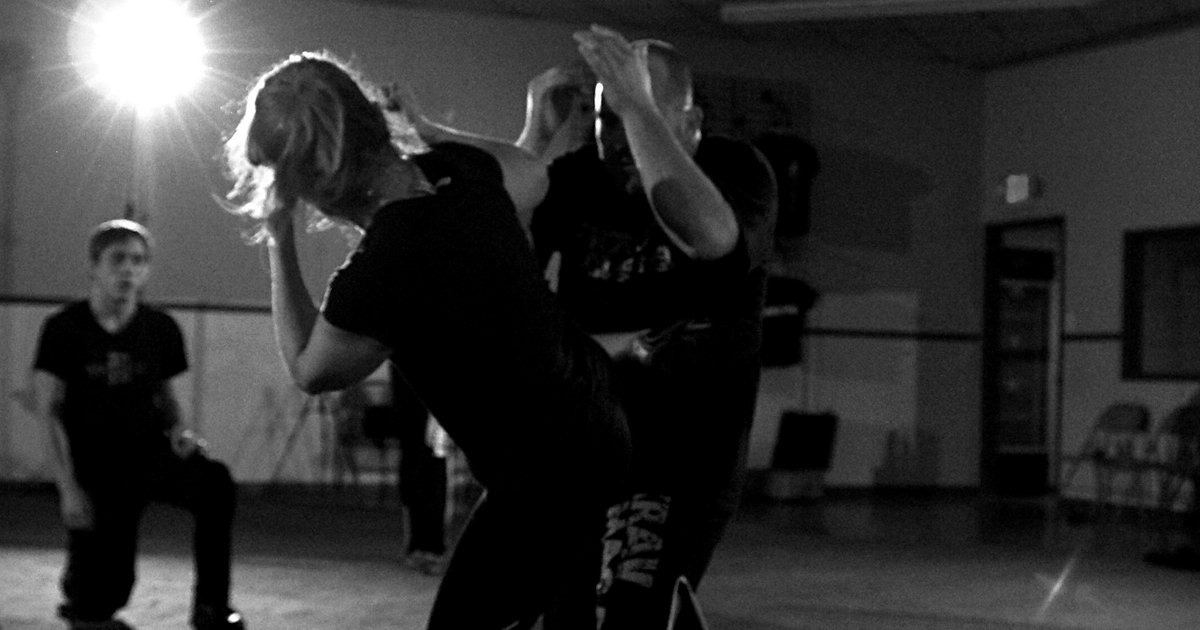
At ETKM, we build our curriculum around this reality. Gross motor techniques come first. Drilling happens under fatigue and time pressure. Scenario work starts before you are ready, with your heart rate already elevated and the situation already moving. We train decision-making alongside physical skills because your hands mean nothing if your brain locks up before they start moving.
The Freeze Response Is Not a Character Flaw
The freeze response gets treated like a personal failure. It is not. It is a neurological response that happens when your brain receives a threat signal it has no trained response for. Your system locks up because it has no program to run.
Gonzales identified the antidote in his survival research: movement is life. Action breeds action. Freezing breeds freezing. The people who survive high-stress events are not the ones who were born tougher. They are the ones who trained themselves to move first and process second.
This is exactly what stress inoculation does. You expose yourself to controlled stress, enough to trigger the adrenaline response, while practicing specific actions. Over time, your nervous system builds a library of responses. When the real moment comes, your brain has something to reach for instead of locking up.
In our classes, this looks like scenario drills with surprise elements. Elevated heart rate before contact. Multiple people closing in. Low light. Verbal chaos. The goal is not to scare you. The goal is to give your nervous system practice. The first time your body changes under threat should not be the worst day of your life.
Varg Freeborn frames it this way: orientation drives the outcome. How you interpret the moment determines every action that follows. Two people can face the same threat. One sees chaos and freezes. The other recognizes a pattern, activates a pre-trained response, and moves. The difference is not talent. It is training.
Pre-Committed Decisions Change the Equation
There is one more piece that separates people who function in crisis from people who do not. It has nothing to do with physical ability.
It is deciding in advance.
Morrison’s framework and the research behind it all point to the same conclusion: the most dangerous moment in a crisis is the decision point. When adrenaline has narrowed your thinking and you have to figure out what to do for the first time, the delay can cost you everything.
Pre-committed decisions remove that variable. You decide now, in calm, what you do when specific things happen. If someone blocks your exit, you move toward the nearest alternate exit. If someone grabs your child, you act immediately. If a verbal situation shows physical indicators, you create distance and set your hands.
The combat profiling research behind Left of Bang puts it simply: early action is always low drama. Reposition, create distance, move toward exits. You do not need certainty to take small protective steps. A person who moves at the first signal of trouble has more options than a person who waits for proof.
The threshold scripting concept puts it clearly. You answer the hard questions now. The answers are already waiting when the moment demands them. The people who do this carry less ambient anxiety, not more. The vague dread that sits underneath unresolved questions is heavier than specific, clear answers.
Preparedness does not create fear. It replaces fear with a plan.
Morrison’s Challenge
Morrison’s second question is not really about being better than other people. It is about being better prepared than your own default biology.
Every person who walks into a crisis without training faces the same cascade of physical and cognitive changes. The question is whether you have given yourself the tools to function inside that cascade. Or whether you are relying on a body and mind running on emergency protocols with no training to guide them.
The answer, like the first question in this series, starts with honesty. It continues on the mat. And the earlier you start, the more prepared you will be when the moment is no longer a drill.
Your Next Step
Schedule your free trial lesson at East Texas Krav Maga. Experience what training designed for real stress conditions feels like. See where you stand when the pressure goes up.
Schedule Your Free Trial Lesson
Want to understand your body’s stress response before you step on the mat? Download our free guide to personal safety and start building awareness today.
Next in the Tier 1 Civilian series: Is Your Preparedness Keeping Up with Your Life?


