The Gap Between Knowing and Doing
You have read Parts 1 through 3 of this series. You understand why your brain freezes under threat. You have three decision templates. You have a mental playbook for four common scenarios.
Here is the hard truth: none of that protects you yet.
Knowing what to do and doing it under pressure are two completely different things.
A student at ETKM once froze for three full seconds the first time genuine surprise pressure was introduced in a drill. This was not a brand-new student. This person had trained techniques for a long time.
They had not failed to remember what to do. They had never trained it against the surprise variable.
That three-second freeze is the gap this article closes.
Why Understanding Is Not Enough
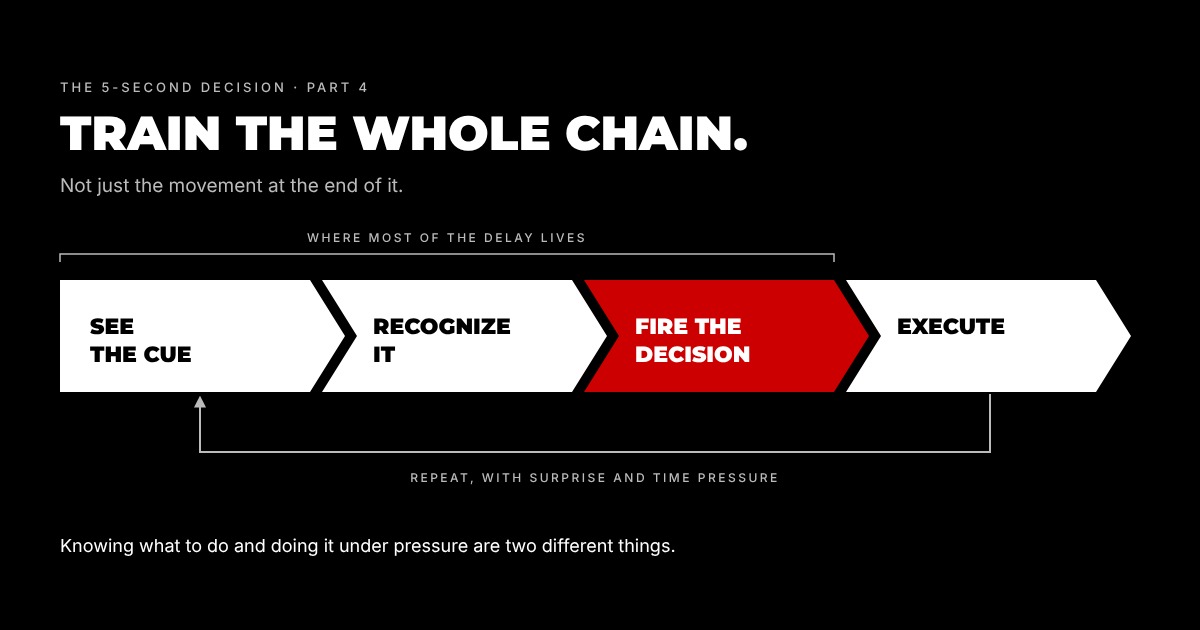
Your brain processes decisions through a chain: detect the threat, decide what to do, then act. Research from Bruce Siddle’s work on combat performance shows that most of the delay happens in detect and decide, not act. Training faster hands without training the recognition and decision steps upstream is like improving the last step while ignoring the bottleneck.
This is why repetition matters. Not repetition of movements alone, but repetition of the full chain. See the cue, recognize it, fire the pre-loaded decision, execute the response.
When you run that chain hundreds of times, your brain stops treating it as a problem to solve. It starts treating it as a pattern to execute.
As Hasard Lee puts it in The Art of Clear Thinking: clear thinking is built through repetition, not inspiration.
What Conditioned Responses Actually Look Like
There is a difference between practicing a technique and conditioning a response.
Practicing a technique means you can perform it when you know it is coming, in a familiar environment, with no time pressure. That is a starting point. It is not readiness.
Conditioning a response means the full chain fires automatically: cue recognition triggers the pre-loaded decision, which triggers the physical action. No pause. No internal debate. The response runs because you have trained it to run.
Siddle’s research documented this pattern with law enforcement officers. Officers with thousands of hours on the shooting range made errors in the field that they never made on the range.
Not because they forgot their training. Because the range did not include the stress variable. The skills that were sharp in a controlled setting broke down the moment real-world conditions showed up.
The difference was not talent. It was training conditions.
How to Train for Automatic Responses
Building conditioned responses takes specific, intentional practice. Here is what that looks like.
Drill With Intent, Not Just Motion
Going through the motions does not build automatic responses. Every repetition needs intent behind it. When you practice a decision template from Part 2 of this series, you are not just rehearsing the physical movement. You are rehearsing the recognition, the decision, and the commitment.
Before you start a drill, picture the scenario. See the cue. Feel the moment of recognition. Then run the response.
That mental engagement separates a rep that builds conditioning from a rep that just passes time.
Add Surprise and Time Pressure
Once the basic movement is clean, start introducing variables. Have a training partner change the scenario without warning. Set a time constraint. Add background noise or distraction.
These variables force your brain to process the full chain under conditions closer to reality.
This is the training principle Siddle calls stress inoculation. You expose yourself to controlled stress in a safe environment so that when real stress arrives, your system has already been there. Your body knows what elevated heart rate and narrowed focus feel like, and your trained responses still fire.
At ETKM, this is built into the progression. Early training gives you the techniques in a controlled setting.
As you advance, the drills add surprise, multiple variables, and pressure. The technique does not change. The conditions around it do.
Train the Full Decision Chain
Most people stop at the physical response. That is only the last step. The full chain looks like this:
See the cue. Your training partner steps into your space, or a scenario begins with an unexpected approach.
Recognize it. You identify this as one of the patterns you have pre-loaded. This is the “being followed” template. This is the “suspicious approach” template.
Fire the decision. The if/then rule you rehearsed runs. No debate. The decision was made weeks ago, in a calm moment, on your terms.
Execute the response. Your body moves. Distance, verbal command, defensive position, escape. The physical action follows the decision automatically because you have paired them together hundreds of times.
Training the full chain is what separates decision-making practice from just technique practice.
Practice Between Sessions
You do not need a training partner or a gym to rehearse your decision templates. Mental rehearsal builds the same neural pathways that physical practice does, just at a lower intensity.
Pick one scenario from your playbook. Close your eyes. Walk through it in real time.
See the environment. See the cue. Feel yourself recognize it. Feel the decision fire.
Watch yourself execute. Make it vivid.
Do this for five minutes, three times a week. It costs nothing. It compounds over time. And it keeps your templates active between sessions on the mat.
The Confidence That Comes From Conditioning
There is a specific kind of confidence that shows up when you have trained something until your body stops asking for permission. It is not bravado. It is not hoping you will remember. It is the quiet knowledge that the response is already loaded.
That confidence changes how you carry yourself. It changes how you enter a room, walk through a parking lot, respond to something unexpected.
You are not running calculations. You are not hoping for the best. You have already decided.
In Part 5, we will cover what happens when the plan does not work. Because no matter how well you have conditioned your responses, real situations throw variables you did not rehearse. The question is not whether that will happen. The question is whether you can adapt when it does.


