Nobody walks into a self-defense class confident. That’s not how it works.
You show up nervous. You feel out of place. The techniques look foreign. Your body doesn’t cooperate. And there’s a voice in your head telling you that everyone else picked this up faster than you.
That voice is wrong. But you won’t believe that until you’ve been through what comes next.
The Four Stages Nobody Tells You About
Every physical skill you’ve ever learned followed the same pattern. Riding a bike. Driving a car. Typing on a keyboard. Self-defense is no different.
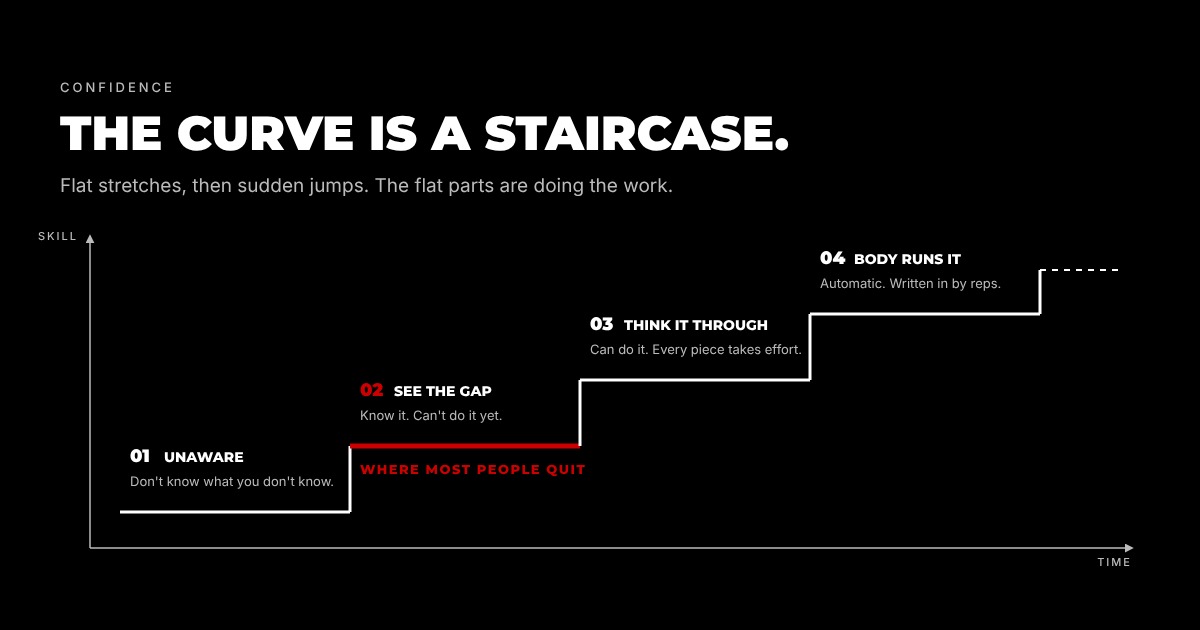
- Stage one: you don’t know what you don’t know. You walk in thinking a fight is about throwing punches. You haven’t seen the problem clearly yet.
- Stage two: you see the gap. You know what you’re supposed to do, and you can’t do it. This is the most uncomfortable stage. It’s also the most important one. Because this is where most people quit.
- Stage three: you can do it, but you have to think about every piece. Your stance. Your hands. Your distance. Your timing. Everything requires conscious effort. It feels slow and mechanical.
- Stage four: your body runs it. You don’t think about the technique anymore. Your hands know where to go. Your feet move without instruction. The skill has been written into your nervous system through repetition, and it fires the same way a trained reflex fires.
Most training programs celebrate stage one and stage four. They skip the middle. But the middle is where perseverance lives. And perseverance is the only thing that turns stage two into stage four.
Why Plateaus Feel Like Failure (And Aren’t)
Six weeks in, something happens that catches most new students off guard. You stop improving.
The techniques you learned quickly in weeks one through four start to feel stale. The new techniques feel impossible. You watch other students who started around the same time and some of them look further along. Your body is tired. Your motivation dips.
This is the plateau. And it’s completely normal.
What’s happening underneath the surface is more important than what you see on top. Your nervous system is consolidating. The motor pathways you’ve been building are strengthening, but the changes are too small to feel. You’re in the gap between conscious effort and automatic execution, and that gap can last weeks.
The learning curve isn’t a smooth upward line. It’s a staircase. Flat periods followed by sudden jumps. The flat periods feel like nothing is happening. But without them, the jumps don’t come.
Most people quit on the plateau. The ones who stay are the ones who build real confidence.
What Your Reps Are Actually Doing
Here’s something that changes how you think about training: every repetition you do is code you’re writing for your autopilot.
Your brain isn’t just storing a technique. It’s building a program that will run automatically when your conscious mind is unavailable. And under real stress, your conscious mind goes offline fast. At high heart rates, complex thinking becomes unreliable. What remains is whatever program your training wrote.
In documented high-stress incidents, people have performed trained actions with no conscious memory of doing them. The thinking brain was offline. The trained body was not. Hands ran the drill they had been given thousands of times. That’s not luck. That’s what repetition is for.
This is why perseverance matters. Not just because it builds character, though it does. Because it builds programming. And programming is what keeps you safe when fear takes over.
The question isn’t whether your autopilot will run in a crisis. The question is what program you gave it.
The Breakthrough You Don’t See Coming
After the plateau, something shifts. And it almost always happens when you’re not looking for it.
You’re running a drill you’ve done a hundred times. But this time, your body moves before your brain gives the instruction. The defense fires. The counterattack lands. The distance is right. And you didn’t plan any of it.
That’s the breakthrough. Not a new technique. Not a harder drill. The moment when something you struggled with becomes automatic.
Students describe it differently. “It just clicked.” “I didn’t think about it.” “My body already knew.” But they’re all describing the same thing: the transition from stage three to stage four. From conscious effort to trained response.
It only happens because of the reps. Because of the days you showed up when you didn’t feel like it. Because of the plateau you didn’t quit on. Because of the hundreds of repetitions that felt pointless at the time but were writing the program your body just ran.
That’s what real confidence is. Not believing you can do something because someone told you so. Knowing you can do it because your body has already done it a thousand times.
The Validation That Matters
There’s a difference between confidence that has been tested and confidence that hasn’t.
You can train a skill every day. But until you test it under time pressure, fatigue, and imperfect conditions, you’re only seeing what you want to see. Comfortable training refuses to hold up the mirror.
That’s why pressure testing matters. Not to break you down. To show you what’s real. When you pass a stress drill, you don’t just feel confident. You have evidence. You’ve seen your own body perform under pressure. That evidence is the foundation of genuine self-confidence.
And when you fail a stress drill, that matters too. Because now you know exactly where the gap is. You can name it. You can train it. You can close it. Failure in training is data, not defeat. It’s a training problem, and training problems have solutions.
The Person Who Shows Up at Month Six
The person who walks through the door on day one and the person who shows up at month six are not the same person. And the difference isn’t technique. It’s identity.
At month six, you don’t hope you could protect yourself. You know what you can do, what you’re still building, and what comes next. You carry yourself differently. You make decisions faster. You trust your own judgment because you’ve tested it under pressure.
That didn’t happen because someone gave you a pep talk. It happened because you showed up when it was hard, stayed through the plateau, and let the reps do their work.
Confidence built this way doesn’t disappear when the situation changes. It follows you into the parking lot, the meeting, the difficult conversation. Because it’s not situational. It’s structural. It’s built into who you are now.
Start Building
You don’t need confidence to start training. You need to show up. The confidence comes from the work.
Schedule your free trial lesson at East Texas Krav Maga. See what the first day feels like. The only thing you need to bring is the willingness to begin.
Not sure you’re ready? Download our free starter guide to learn what to expect before your first class.


