You are training to take a knife away from someone. Have you thought about what happens after you do?
There is a good chance you got cut during the disarm. Maybe your forearm. Maybe your hand. Blood is coming fast and you are still running on adrenaline. The threat is down, but you are standing in a parking lot with a wound that needs pressure in the next sixty seconds.
Do you know what to do right now?
Most people do not. They trained for the fight. They did not train for the aftermath. That is a gap, and at ETKM, we do not leave gaps.
Self-defense training that stops at the fight is like a fire drill that ends before anyone learns where the exits are. You practiced the response. You skipped the survival part.
The Argument Nobody Makes
Most self-defense programs stop at the fight. They teach you how to defend against a knife, strip a handgun, or deal with a blunt weapon. That matters. But it is only half the problem.
Here is the part nobody talks about: if you are training weapon disarms, you are training for scenarios where someone gets hurt. Maybe the attacker. Maybe a bystander. Maybe you. The question is not whether injuries happen in weapon encounters. The question is whether you can do anything about them.
At ETKM, we teach Tactical Medical Response, or TACMED, alongside advanced weapon defense for one reason. You should be able to treat what you might cause or receive.
That is not an add-on. That is the other half of the skill.
Why TACMED Belongs in Your Training
Think about what your body does under threat. Lt. Col. Dave Grossman’s research in On Combat documented it clearly. When your heart rate climbs above 115 beats per minute, fine motor skills start to degrade. Above 175 bpm, complex motor skills and higher-level thinking become unreliable. Gross motor skills stay functional, but the precision work your hands do every day disappears.
Now picture yourself trying to apply a tourniquet for the first time while your heart is pounding at 160 bpm. Your hands are shaking. Your fingers will not cooperate with the buckle. You have never practiced this under stress. The package instructions made sense when you read them at home. Right now, they might as well be in another language.
This is why we train TACMED the same way we train combatives. Under stress. With repetition. Until the skill lives in your hands, not in your head.
Grossman puts it simply: you do not rise to the occasion. You default to your training.
If you have never trained to stop bleeding under pressure, you will not suddenly figure it out when the moment arrives.
What We Actually Teach
TACMED at ETKM covers three critical areas. Each one addresses what is most likely to kill someone in the minutes between an injury and when EMS arrives.
Hemorrhage control. This is the priority. Uncontrolled bleeding is the leading cause of preventable death in trauma. We teach tourniquet application, wound packing, and direct pressure. You learn when each method is appropriate. You learn to apply a tourniquet to your own arm with one hand. You learn to pack a wound using hemostatic gauze. And you practice all of it after your heart rate is already elevated, because that is the only condition that counts.
A tourniquet sitting in your range bag does not save your life. A tourniquet you can apply in under thirty seconds with wet, shaking hands does.
Airway management. A person who cannot breathe has minutes, not hours. Severe trauma to the face, neck, or chest can compromise the airway fast. We teach how to position an injured person, how to clear an obstruction, and how to recognize the signs that an airway is failing. This is not paramedic-level training. It is keep-them-alive-until-EMS-arrives training.
Shock management. After a serious injury, the body starts shutting down blood flow to non-essential systems. Shock can kill someone who survived the initial wound. We teach how to recognize it and manage body position. How to keep someone conscious and stable while help is on the way.
How We Train It
Reading about TACMED in a blog post is not the same as doing it. And doing it in a calm classroom is not the same as doing it after a combatives drill.
That is the difference at ETKM. We do not teach medical skills in isolation. We integrate them into scenario-based training.
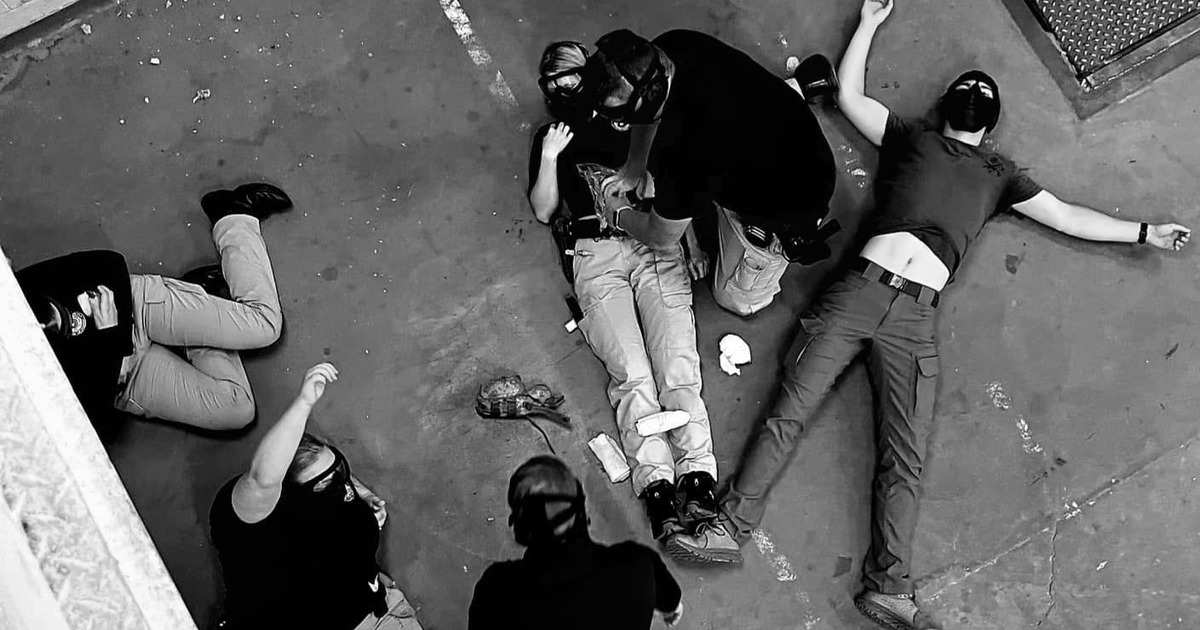
Here is what that looks like. You run a weapon disarm scenario. The drill is live, the pressure is real, your heart rate is up. The scenario ends and the instructor calls a medical emergency. Now you are transitioning from fighting to treating. Your partner has a simulated wound on their forearm. You have to locate your kit, apply a tourniquet, and verbalize what you are doing. Your nervous system is still running hot from the confrontation.
That transition is where most people fail the first time. Hands that were throwing strikes thirty seconds ago cannot find the clasp on a tourniquet. The voice that was shouting commands goes quiet when it needs to talk through a medical protocol.
The first time you run this drill, you will probably fumble. The third time, you will be faster. By the tenth time, the transition from combatives to care becomes a trained response. You stop thinking about it and start doing it.
That is exactly why we train it.
Training only under comfortable conditions is like a pilot who only practices landings in clear weather, as Grossman writes. The skill looks real. It will not hold in a storm. Stress inoculation is the storm, delivered safely, before you need it.
The Aftermath Protocol
Tim Larkin lays out a clear sequence in When Violence Is the Answer. After a violent encounter: safety first, then authorities, then medical. Then articulate what happened and why.
Notice where medical falls. Third. After you have secured safety and called for help. But here is the reality. EMS response time in Tyler, Texas, is measured in minutes. A major bleed can be fatal in two to three. The math does not work if you wait for someone else to handle the medical piece.
You are the first responder. Not because you want to be. Because you are the one standing there.
TACMED training does not make you a paramedic. It makes you the person who can keep someone alive in the gap between injury and professional care. That gap is measured in minutes, not hours. And in those minutes, outcomes are decided by whoever is standing closest to the injury.
That person will probably be you. The question is whether you are ready.
Who This Training Is For
Every student who trains weapon disarms at ETKM gets exposure to TACMED concepts. But the training is especially relevant for a few groups.
If you carry a firearm for personal protection, you should be able to treat a gunshot wound. Yours or someone else’s. Carrying a weapon without carrying the medical knowledge to deal with its consequences is an incomplete plan.
If you work in law enforcement, security, or any role where you might encounter violence, this is not optional. It is operational readiness.
If you are a parent with a firearm in the home, knowing how to stop a bleed matters as much as knowing how to clear a malfunction.
And if you train knife defense, gun disarms, or stick defense, you need to understand the medical realities of those scenarios. The training room is controlled. The street is not.
Your Kit Is Part of Your Training
TACMED training is not just knowledge. It is also gear. At ETKM, we encourage every student in advanced weapon defense to carry a basic Individual First Aid Kit, or IFAK.
What goes in it matters less than whether you can use what is in it. A tourniquet you have never practiced with is dead weight. A chest seal you have never opened under stress is a plastic wrapper, not a medical tool.
We train with the same gear you carry. You learn to open your kit under pressure. You learn which pocket to reach for. You learn to apply your own tourniquet in the dark, with one hand, after exertion. That specificity is the difference between a kit and a capability.
If you carry a firearm, you probably train with it regularly. Your IFAK deserves the same attention. Both tools exist for the same reason. Both are useless without practice.
This Is What Complete Training Looks Like
Most programs teach you how to survive a fight. At ETKM, we teach you how to survive what comes after.
You learn to stop the threat. Then you learn to stop the bleeding. Then you learn to manage the scene until help arrives. That is the full picture.
The question is not whether you will ever need this training. The question is whether you could live with knowing you had the chance to learn it and did not.
If you are already training weapon defense, TACMED is the next step. If you have not started yet, this is what serious training looks like from day one.
Your Next Step
Schedule your free trial class at East Texas Krav Maga. See how we train. Ask about our TACMED integration. We will show you what prepared actually looks like.
Schedule Your Free Trial Class
Want to learn more about our advanced training programs first? Contact us directly and we will walk you through what is available.


