Article 3 of 7 in the Psychology of Combatives Series
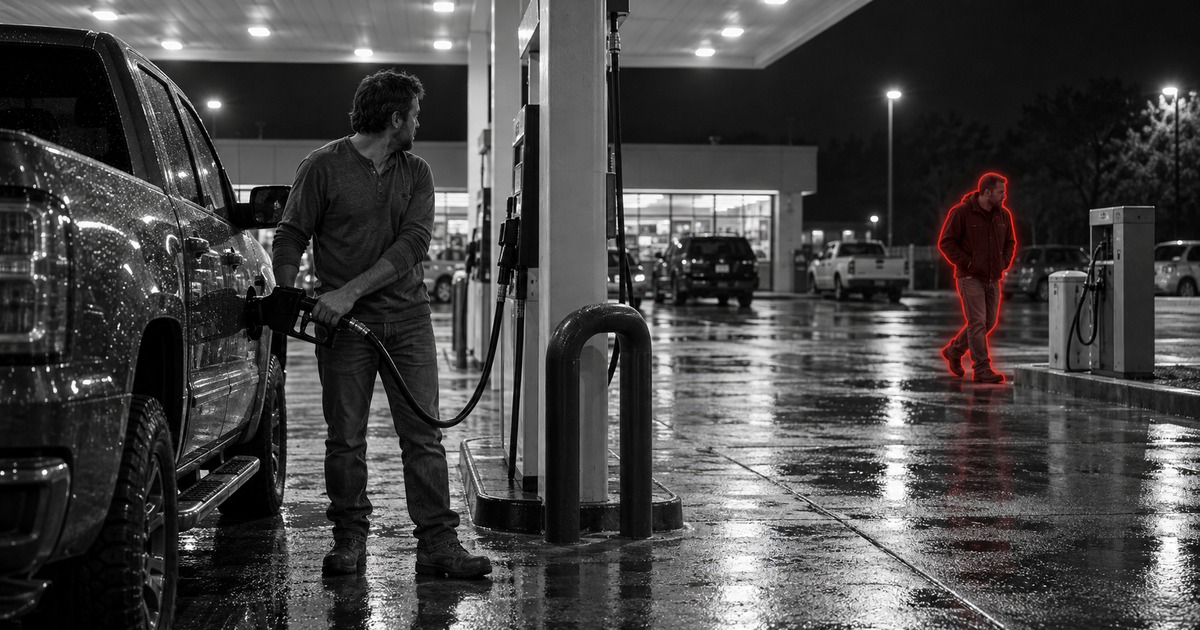
You see the guy at the gas station before he sees you. He’s pacing near the air pump. Hands in and out of his pockets. Looking around more than someone filling tires would. You notice all of it.
Now what?
Most people think situational awareness is about spotting danger. It is. But spotting it is only the first step. What you do with what you see is where awareness becomes a real skill. And more often than not, what you do next involves your mouth before your hands.
This is Article 3 in the Psychology of Combatives series. Where Article 1 covered managing your internal state under stress, this one covers reading the external environment and responding to it with more than just physical technique.
You Can’t See Abnormal If You Don’t Know What Normal Looks Like
The biggest mistake people make with situational awareness is looking for threats without first knowing what “not a threat” looks like. Threat detection is not a personality trait or a gift. It is a trainable system.
That system starts with baselines.
A baseline is what normal looks like in a given environment. The pace of foot traffic in a parking lot. The volume of conversation in a restaurant. The distance people keep from strangers at an ATM. These aren’t things you consciously catalog. But once you start paying attention to them, deviations become obvious.
When someone’s behavior doesn’t match the baseline of the space they’re in, that’s data. Not proof of danger. Data. One deviation could be nothing. But when you see two or three deviations clustering together, you’re looking at a pattern. And patterns are worth acting on.
We teach four domains to scan: body language (how people carry themselves), distance (how close someone is to you and whether it’s appropriate), geography (who is positioned where relative to exits, cover, or you), and atmosphere (the general vibe of the space). This framework comes from Left of Bang, one of the books we use in our training curriculum. When two or more of those domains show deviations at the same time, you have a cluster. And when you have a cluster, you move.
That movement doesn’t have to be dramatic. Early action is always low drama. Reposition. Create distance. Move toward exits. Walk toward other people. The earlier you act on what you see, the less force you need.
Your Phone Is an Advertisement
One of the most consistent findings in studies of opportunistic crime is that distraction in transitional spaces is the single biggest factor in target selection. Transitional spaces are places where you’re moving between one environment and another: parking lots, ATMs, building entrances, gas stations.
When you’re looking at your phone in a parking lot, you’re not just distracted. You’re advertising that you’re distracted. Your head is down. Your awareness is somewhere else. Your reaction time just tripled.
Phone down in transitional spaces. It’s one habit. It costs you nothing. And it changes what a potential threat sees when they look at you.
When Words Come Before Hands
Most confrontations don’t start with a punch. They start with words. Someone in your face. Someone following you. Someone testing whether you’ll respond. How you handle that verbal phase often determines whether a physical phase happens at all.
Not all confrontations are the same. Status contests are about ego. The other person needs to feel like they won something. Fear-based confrontations come from someone who feels cornered or threatened. Resource conflicts are about something concrete: a parking spot, a place in line, money. And predatory behavior is none of those. It’s calculated, and talking won’t fix it.
Why this matters: the tool you use has to match the type of conflict you’re in. Trying to reason with someone in a status contest makes things worse. Offering a face-saving exit usually ends it. Trying to de-escalate a predator wastes the time you need to create distance.
The words you reach for under stress are almost always the wrong ones. Training de-escalation means learning to diagnose the situation before choosing words. To lower the temperature instead of matching it. To offer options early, before the other person feels trapped.
Three principles that apply directly:
Empathy absorbs tension. You don’t have to agree with someone to acknowledge what they’re feeling. “I can see this is frustrating” is not weakness. It’s a calming signal that costs you nothing and buys you time.
The more ego you show, the less power you have. When you escalate your voice or your posture to match someone who’s aggressive, you’ve handed them control of the interaction. Staying level doesn’t mean you’re passive. It means you’re choosing where this goes instead of reacting to where they’re taking it.
Never use the words that rise readily to your lips under stress. The automatic response, the comeback, the sarcastic line that feels satisfying in the moment, almost always makes things worse. Replace it with something that gives the other person a way out.
What This Looks Like
There’s a story we share in training about a jogger who spots three men blocking his path. Instead of freezing or charging through, the jogger asks if they’ve seen two guys walk this way: “one of them a really big guy, body builder type, walking a Rottweiler.” The men freeze. The jogger says “never mind, they must be up ahead” and runs off. No confrontation. No contact. Just awareness, fast thinking, and words that changed the equation.
That’s what trained situational awareness looks like. Not a fighting stance. Not a weapon draw. A person who saw the problem early enough to solve it with something other than force.
Where This Connects
Article 1 in this series covered managing your internal state. This article covered reading the environment and responding verbally. Article 5 covers how your body language communicates before you say a word. Together, they form the pre-contact layer of self-defense: the skills that prevent fights from happening in the first place.
Training your awareness and your communication isn’t a substitute for physical technique. It’s the layer that determines whether you ever need to use it.
Start your free trial class at East Texas Krav Maga and train the complete system: mind, body, and the skills that connect them.


