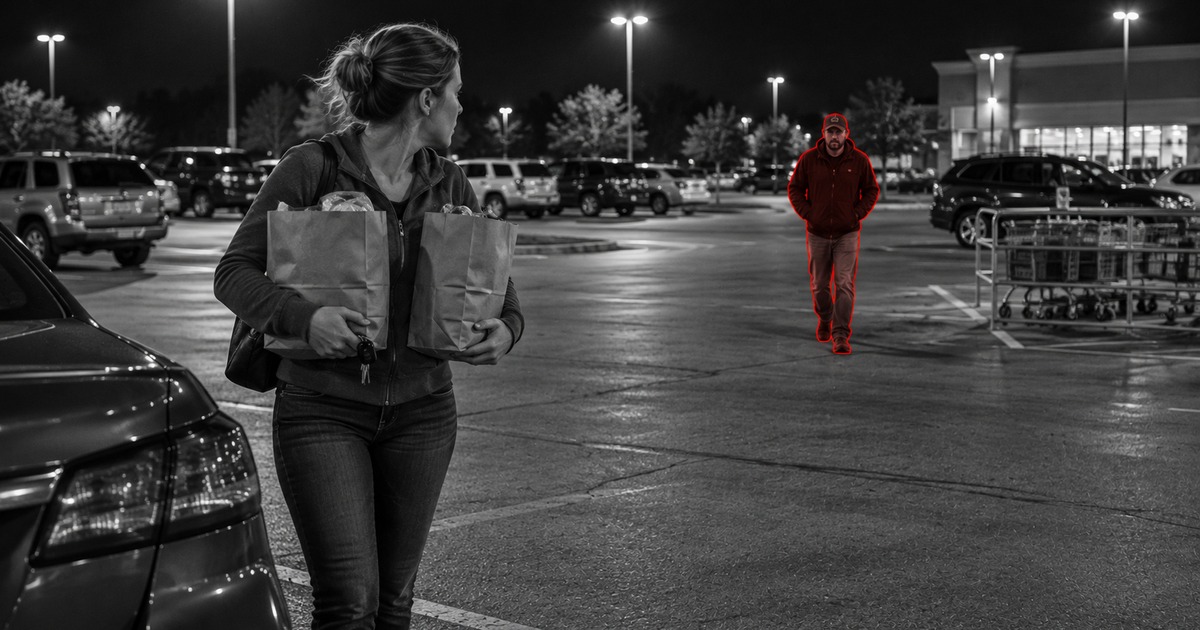
You are in a parking lot. It is 9 PM. You are carrying two bags of groceries, keys in your right hand, phone in your pocket. Thirty feet away, someone changes direction and starts walking toward you.
What do you do?
If you had to think about it, that pause is the problem this entire series is built to solve.
The Moment Your Brain Goes Quiet
Most people assume they will know what to do if something goes wrong. They picture themselves acting fast, staying calm, making smart choices. But under real threat, the brain does not work that way.
When danger registers, your sympathetic nervous system floods your body with adrenaline and cortisol. Heart rate spikes. Blood moves away from your hands and into your core. Fine motor skills start to fail. And the part of your brain responsible for creative problem-solving, the prefrontal cortex, starts shutting down.
This is not a character flaw. It is biology. Under survival stress, your brain runs what researchers call the Detect, Decide, Act chain. It tries to detect what is happening, decide what to do about it, and then act. The problem: for someone who has never rehearsed a response to that specific type of threat, the Decide phase stalls. Your brain searches for an answer it was never given.
This pattern shows up across disasters, from plane crashes to building fires. The brain’s first response to danger is not escape. It is explanation. People freeze because they are trying to make the situation make sense, and the situation is not cooperating. This is called normalcy bias: your brain insists that things should be normal, even when the evidence says otherwise.
That is what a freeze looks like from the inside. Not cowardice. Not weakness. Your brain is running a search with no results.
What Freezing Actually Costs
A violent encounter unfolds fast. Research on assaults and ambushes consistently shows that the window between first contact and outcome is measured in seconds, not minutes. The truth is simple: indecision is still a decision. It just costs more than a wrong one.
In the parking lot scenario, the person approaching you will close thirty feet in roughly four to five seconds at a fast walk. That is the entire decision window. If your brain is still trying to understand what is happening at second three, you have already lost most of your options.
Survival research reduces the pattern to a single line: people do not die from lack of strength or lack of courage. They die of confusion. The brain could not sort the situation fast enough to produce action.
The Fix Is Not Faster Thinking
Here is the part most people get wrong. The answer is not to think faster under stress. You cannot. Once adrenaline hits a certain threshold, your higher-order thinking degrades whether you want it to or not.
The answer is to think less.
Specifically, the answer is to make your critical decisions before the event ever happens. In self-defense training, this is called decision pre-loading: you pre-commit your responses to common threat cues so that when the moment arrives, your brain does not need to generate a plan. It retrieves one.
The difference in speed is dramatic. An untrained decision under surprise takes seconds. A pre-loaded decision, one that was rehearsed before the event, takes fractions of a second. The fastest survivors in every disaster study share this pattern: they reached decisive action sooner not because they were braver, but because they had compressed the time between recognition and response.
Early movement is cheaper than late heroics. A decision made before the crisis, even an imperfect one, beats a perfect decision made too late.
Decision pre-loading works like an if/then rule. If someone approaches me aggressively in a parking lot, then I move toward the nearest populated area and create distance. If I hear glass breaking downstairs at 2 AM, then I lock the bedroom door, call 911, and arm myself with whatever is available. The decision is already made. The event just triggers it.
You do not need dozens of these. You need a handful of clear, rehearsed responses for the situations most likely to affect you. That is what this series will build.
What This Series Covers
The 5-Second Decision is a six-part series. Each part gives you something specific to practice.
Part 2 introduces three decision templates that work when thinking stops: Escape Route First, Loud and Clear, and Self-Defense Ready. These are the if/then rules you will actually load.
Part 3 builds your mental playbook for four common threats: being followed, a verbal confrontation, a home invasion, and a physical assault. Each one gets a specific pre-loaded response.
Part 4 shows how repetition turns those templates into automatic responses. Knowing what to do is not the same as being able to do it under stress. This part bridges the gap.
Part 5 covers what to do when the plan breaks down. No template covers every situation. You need a method for adapting under pressure when reality does not match your rehearsal.
Part 6 is the capstone. It integrates mental preparation and physical training into one system, so your decision-making and your body work together instead of separately.
By the end of the series, you will have a small set of pre-loaded decisions, the practice methods to make them automatic, and a framework for adapting when things go sideways.
Start Training Your Decisions Now
Reading about decision-making is a first step. Training it is what changes the outcome. At East Texas Krav Maga, the scenarios in this series are the same ones we train in class, under stress, with resistance, until the response stops being something you think about and becomes something you do.
Schedule your free trial lesson and find out what trained decision-making feels like when the pressure is real.


